So your fish are staring at you through cloudy water and you’re wondering what went wrong. Nine times out of ten, it’s the filter — either the wrong one, the wrong media, or nobody’s cleaned it since the tank was set up. I’ve torn apart more filters than I care to admit over the years, and almost every “mystery” water problem traces back to filtration basics that got skipped.
Key Takeaways
| Question | Quick Answer |
|---|---|
| What are the 3 types of filtration? | Mechanical, biological, and chemical — you need all three working together |
| How big a filter do I need? | Rated for 4-6x your tank’s gallons per hour, more for messy fish |
| How often should I clean a filter? | Rinse mechanical media weekly-ish, never scrub biological media in tap water |
| Can a filter be too strong? | Yes — betta and fry tanks need gentle flow, not a wave machine |
| What kills the good bacteria? | Chlorine, hot tap water, and cleaning all your media at once |
Why Filtration Isn’t Just a Box That Hums in the Corner
A filter isn’t decoration. It’s the thing standing between your fish and their own waste, and honestly, most beginners underestimate how much work it’s actually doing every single hour. Fish poop, uneaten food, and dead plant bits all need somewhere to go, and “somewhere” is your filter, not the water column.
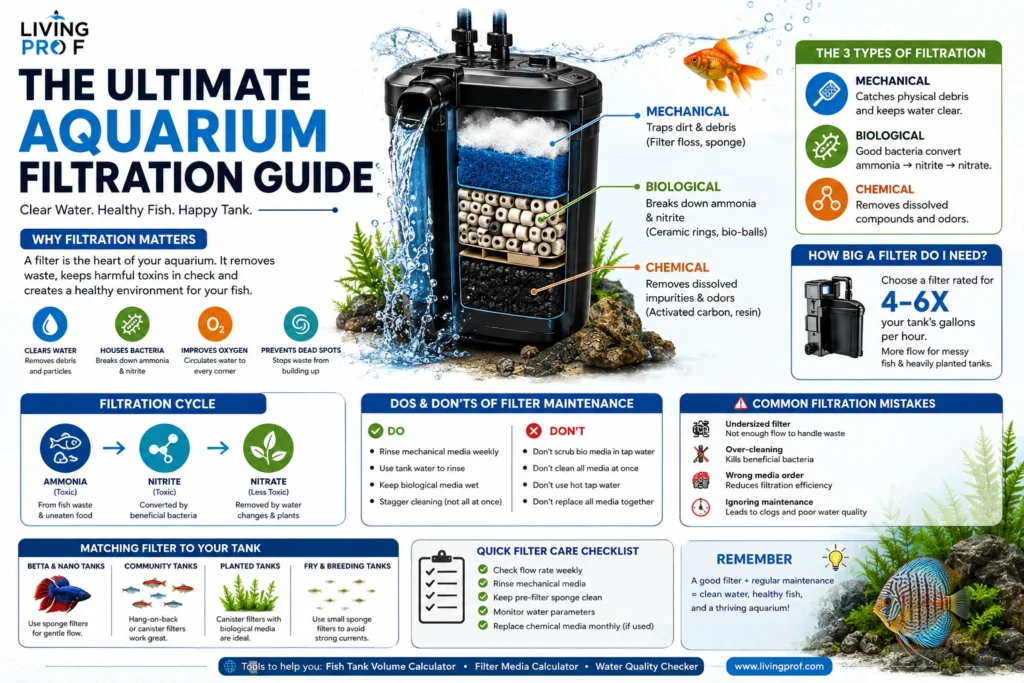
Here’s the part nobody explains well: fish waste turns into ammonia, which is toxic even in tiny amounts. Ammonia gets converted to nitrite (also toxic), then to nitrate (less toxic, but still needs managing with water changes). This whole chain is called the nitrogen cycle, and your filter’s biological media is where it actually happens.
Skip good filtration and you’re not just risking cloudy water — you’re risking common freshwater fish diseases that show up the moment water quality dips. Stressed fish in dirty water get sick fast. I’ve watched a perfectly healthy shoal go downhill in under a week because a filter got unplugged during a power outage and nobody noticed for two days.
A few things a working filter does that people forget:
- Clears the water so light actually reaches your plants
- Hosts bacteria colonies that process waste before it builds up
- Circulates water so oxygen reaches every corner of the tank
- Prevents dead spots where debris just sits and rots
If you’re still figuring out how much tank you’re even working with, run your numbers through the fish tank volume calculator first — filter sizing is meaningless without knowing your actual gallons.
Mechanical, Biological, and Chemical: The Three Jobs Every Filter Does
Ask five aquarium people what filtration means and you’ll get five different answers, but really it boils down to three jobs happening at once inside that box.
Mechanical filtration catches physical junk — floating debris, leftover food, plant leaves. Think of it as a strainer. Filter floss and sponges do this job, and they need rinsing regularly or they just clog and stop pulling water through.
Biological filtration is the real engine of the whole system. Beneficial bacteria colonize the media (ceramic rings, sponges, bio-balls, whatever you’re using) and convert ammonia into nitrite, then nitrite into nitrate. This is the part that actually keeps fish alive long-term, not the mechanical straining.
Chemical filtration uses activated carbon or resins to pull dissolved stuff out of the water — medications after a treatment, tannins from driftwood, odors. It’s optional for most setups and honestly gets overused; carbon can strip out trace elements your plants need too.
Quick breakdown of what does what:
| Filtration Type | What It Removes | Common Media |
|---|---|---|
| Mechanical | Solid debris, particles | Filter floss, sponge |
| Biological | Ammonia, nitrite | Ceramic rings, bio-balls, sponge |
| Chemical | Dissolved compounds, odors, tannins | Activated carbon, resin |
Most hang-on-back and canister filters run all three stages in sequence — mechanical first so debris doesn’t clog the biological media, then biological, then chemical last. Order matters more than people realize; put carbon before your bio-media and you’re just filtering the water before the bacteria get a shot at it.
Picking a Filter That Actually Matches Your Tank
There’s no single “best” filter — there’s only the right filter for your specific setup, and that depends on tank size, how messy your fish are, and honestly your own patience for maintenance.
A rough rule of thumb: your filter should turn over the entire tank’s water volume 4 to 6 times per hour. A 20-gallon tank wants a filter rated around 80-120 GPH. Messy eaters like oscars or goldfish push that number higher; delicate setups with bettas or shrimp want it lower and gentler.
Filter types you’ll run into:
- Sponge filters — gentle, cheap, great for fry tanks and bettas, weak on mechanical filtration
- Hang-on-back (HOB) filters — the everyday workhorse for most community tanks
- Canister filters — bigger capacity, quieter, ideal for larger or heavily stocked tanks
- Internal filters — compact, good for small or nano tanks
- Sump systems — mostly a reef-tank thing, huge capacity but a bigger commitment
If you’re stocking a peaceful mixed tank, match your filter choice to your actual stocking plan — check out best freshwater community fish combinations before buying anything, since a tank full of active swimmers needs more turnover than a shrimp-and-snail setup.
For anyone weighing specific models rather than just categories, the 10 best aquarium filters for freshwater and reef tanks roundup covers actual tested units instead of manufacturer specs alone. And don’t guess on equipment sizing across the board — the tank capacity and equipment guide walks through matching filters, heaters, and lighting to your exact gallons.
One thing I’d tell any beginner: buy a filter rated slightly above your tank size, not below. Undersized filters are the single most common mistake I see, and upgrading later means re-cycling everything.
Filter Media 101: What Goes Where and Why
Media is where people either get filtration right or waste a lot of money on stuff their tank doesn’t need. Not every filter needs every type of media, and stacking too much chemical media in a tank that doesn’t need it is basically just throwing money at your filter for no reason.
Layering order matters. Water should hit mechanical media first, then biological, then chemical last if you’re using it at all. Doing this backward means debris clogs your bio-media and your bacteria colony suffers.
Common media types worth knowing:
- Filter floss/pads — cheap, replace often, catches fine particles
- Sponges — dual purpose, mechanical and biological
- Ceramic rings/bio-balls — massive surface area for bacteria, rarely needs replacing
- Activated carbon — chemical filtration, replace every 3-4 weeks when used
- Filter floss for polish — final pass for crystal-clear water
Here’s a mistake I made early on: I replaced all my media at once during a big cleanup because I wanted everything looking fresh. Ammonia spiked within 48 hours and I lost fish over it. The bacteria live on the media, not in the water — wipe out the media and you’ve wiped out your cycle.
Not sure how much media your specific filter actually needs, or whether you’re under- or over-stocked on bio-media for your bioload? The filter media calculator does the math instead of you guessing based on a forum post from 2019.
Rule I stick to now: rotate media replacement, never do it all in one go, and always rinse ceramic or sponge media in removed tank water, never tap water. Chlorine in tap water kills the bacteria you’re trying to protect.
Cycling and Setup: Don’t Add Fish Before This Is Done
This is the step everyone wants to skip, and it’s the step that causes the most dead fish in month one. A brand-new filter has zero established bacteria. Add a full stock of fish to an uncycled tank and you’re basically poisoning them with their own waste while the bacteria colony scrambles to catch up.
Fishless cycling is the safer route — dose ammonia into an empty tank and let bacteria build up over 4-6 weeks, testing until ammonia and nitrite both read zero and nitrate is present. It’s slower but nobody dies waiting.
Steps for a basic fishless cycle:
- Set up tank, filter, heater, and get water parameters stable
- Add a small dose of pure ammonia daily
- Test water every 2-3 days for ammonia, nitrite, and nitrate
- Watch ammonia and nitrite spike, then drop to zero as bacteria establish
- Once both read zero consistently and nitrates show up, you’re cycled
Temperature stability matters here too — bacteria growth slows in cold water, so keep things in your target range with a reliable aquarium heater and check it with an actual aquarium thermometer rather than guessing by feel.
You can speed things up by seeding your new filter with media from an already-established tank — a chunk of ceramic rings or a piece of mature sponge dropped into your new filter transfers bacteria instantly instead of starting from scratch. IMO this is the most underused trick in the hobby; ask any local fish store if they’ll spare a handful of used media and most will.
Skipping this step isn’t dramatic at first — the water looks fine, fish seem okay — right up until it isn’t. Ammonia poisoning shows up as gasping at the surface, red or inflamed gills, and lethargy, and it moves fast once it starts.
Filtration Mistakes That Quietly Wreck Your Water
Some mistakes are loud and obvious. Filtration problems are usually quiet — water looks fine for weeks, then suddenly it isn’t, and you’re left wondering what happened.
Cleaning everything at once tops the list, as covered above, but it bears repeating because it’s genuinely the #1 cause of “my tank crashed for no reason” posts online.
Other quiet killers:
- Undersized filters that can’t keep pace with the actual bioload
- Letting mechanical media clog completely, which chokes flow through the whole unit
- Using tap water to rinse bio-media, killing bacteria with chlorine or chloramine
- Running carbon indefinitely, which stops removing anything useful after a few weeks and can even leach material back into the water
- Ignoring flow direction, creating dead zones where debris just settles and rots
Poor filtration doesn’t just mean dirty water — it directly opens the door to disease. Stressed, ammonia-exposed fish have weaker immune systems, and that’s exactly when parasites and bacterial infections take hold. If you’re already seeing symptoms, the common freshwater fish diseases guide walks through identifying what you’re dealing with, and treatments like praziquantel matter a lot less if the underlying water quality issue never gets fixed.
Flow rate mistakes go both directions too. Too weak, and you get dead spots with poor oxygenation. Too strong, and you’re stressing out fish that aren’t built for a current — bettas in particular hate being blasted around their own tank, and their fins take the damage from fighting the flow all day.
Honestly, the fix for most of this is boring: check your filter weekly, rinse gently, replace media in stages, and don’t ignore a filter that’s suddenly quieter or slower than usual. A change in sound or flow is your filter telling you something’s clogged.
Matching Filtration to Your Specific Setup
Different tanks genuinely need different filtration approaches, and treating a planted shrimp tank the same as a monster fish setup is a recipe for problems either way.
Community and beginner tanks — a solid HOB or canister filter handles most peaceful community setups fine. Fish like guppies, corydoras, and angelfish do well with standard moderate flow and don’t need anything exotic in the filtration department.
Betta and fry tanks — go gentle. A sponge filter is nearly always the right call here since bettas and baby fish can’t fight strong current. Check the betta fish care guide for flow-rate specifics if you’re setting one up.
Planted tanks — filtration needs to work alongside your CO2 and lighting setup, not against it. Too much surface agitation from your filter outflow can gas off your CO2 before plants use it. Pair your filtration choice with a proper CO2 system and LED aquarium lighting setup so all three work together instead of fighting each other.
Discus tanks — discus are picky about water quality and want gentle, consistent flow with heavy biological capacity. The discus fish tank requirements guide goes deeper on why these fish punish sloppy filtration harder than most species.
Monster fish and big bioloads — oscars, big cichlids, and other large messy eaters need serious filtration capacity, often canister filters rated well above the tank’s actual gallons. If you’re going big, how big do Oscar fish get and the monster exotic giant aquarium fish care guide both cover the reality of feeding and filtering fish that can produce shocking amounts of waste for their size.
Breeding setups — if you’re breeding, filtration needs adjusting for fry survival too; the breeding aquarium fish complete care guide covers filter intake guards and flow adjustments so you don’t lose a batch of fry to your own filter intake.
Keeping It Running: A Realistic Maintenance Schedule
A filter isn’t “set and forget,” even though plenty of people treat it that way until something goes wrong. Realistically, most filtration problems come from maintenance drift — small delays that add up over months.
Here’s the schedule I actually follow, not the idealized one from the box instructions:
| Task | Frequency |
|---|---|
| Rinse mechanical media (floss/sponge) | Every 1-2 weeks |
| Check flow rate/output strength | Weekly, just glance at it |
| Replace chemical media (carbon, if used) | Every 3-4 weeks |
| Rinse biological media | Every 4-6 weeks, tank water only |
| Full filter teardown and inspection | Every 3-6 months |
| Check tubing/impeller for buildup | Every 3-6 months |
Never rinse all your media on the same day. Stagger it — mechanical this week, biological in three weeks, so your bacteria colony never takes a full hit at once.
Airflow and water flow both matter for oxygenation too, especially in warmer tanks where oxygen holds less easily. If your filter alone isn’t providing enough surface movement, an aquarium air pump adds backup circulation without disturbing bottom-dwellers.
For anyone managing multiple tanks, honestly, the maintenance schedule is where most people burn out. It’s not glamorous work, and it’s the least fun part of the hobby, but it’s also the part that actually determines whether your fish are thriving or just surviving. Set calendar reminders if you have to — I do, and I’ve been doing this for years.
Browse more species-specific setups and equipment breakdowns over on the aquarium fish hub, or check the full tools section for calculators that take the guesswork out of stocking, lighting, and filtration sizing.
Frequently Asked Questions
How long does it take for a new filter to fully cycle? Usually 4-6 weeks for a fishless cycle to fully establish. Seeding with mature media from an existing tank can cut that down to a couple of weeks.
Can I use two filters on one tank? Yes, and it’s actually a smart backup plan. Running two smaller filters instead of one large one also means you’re never without filtration if one needs cleaning or breaks down.
Do I need chemical filtration all the time? No. Most tanks don’t need carbon running constantly — it’s mainly useful after medicating a tank or dealing with tannins and odors, not as a permanent fixture.
Why does my filter suddenly sound louder or weaker? Usually a clogged intake, worn impeller, or media that needs rinsing. A change in sound is almost always a maintenance signal, not something to ignore.
Is a bigger filter always better? Not always — oversized filters can create too much current for delicate or slow-moving fish. Match filter strength to your actual stock, not just your tank size.
What’s the difference between a HOB filter and a canister filter? HOB filters hang on the back of the tank and are easier to maintain; canister filters sit externally, hold more media, and generally handle bigger bioloads more quietly.