Your fish don’t care about “ambiance.” They care about not getting sunburnt algae soup for a home. Get the lighting wrong and you’ll either be scraping green film off the glass every other day, or staring into a tank so dim it looks like a fish funeral. Neither is fun, and I’ve done both, so let’s sort this out properly.
Key Takeaways
| Question | Quick Answer |
|---|---|
| How many hours a day? | 8–10 hours for most freshwater tanks, less for low-tech setups |
| Fish-only tank or planted? | Fish-only needs far less light than a planted tank |
| Signs of too much light | Green water, algae on glass, plants turning brown at the tips |
| Signs of too little light | Leggy, pale plants and a tank that looks flat and lifeless |
| Best tool to fine-tune it | Use the aquarium lighting calculator to match light to your exact tank |
| Timer worth it? | Yes, always. Consistency beats intensity every time |
Why Aquarium Lighting Isn’t One-Size-Fits-All
A ten gallon betta bowl with no plants and a 300 litre planted discus tank have nothing in common lighting-wise, and yet people keep asking for “the” answer. There isn’t one. What matters is what’s actually living in the water and what’s growing in there with it.
Fish-only tanks need light mostly so you can see the fish, and so they get a normal day-night rhythm. That’s it. A moderate light on a timer does the job. Planted tanks are a different beast entirely, because the plants are photosynthesising, competing with algae for nutrients, and often paired with CO2 injection to keep growth balanced.
If you keep species like discus or corydoras catfish, you’re dealing with fish that come from shaded, tannin-stained rivers in the wild. Blast them with a reef-grade light and watch them hide behind the filter intake all day. On the flip side, a bare betta tank under betta care basics barely needs more than a modest desk lamp equivalent.
So before you even think about wattage or lumens, ask what you’re actually trying to light up. Fish that hug the shadows? Go dim. A carpet of dwarf hairgrass? You’re going to need serious output, and probably a CO2 system to match it, or the plants will just stall out and rot.
How Many Hours Should Aquarium Lights Stay On?
This is the question I get asked most, and IMO it’s also the one people overthink the most. Fish and plants both need darkness. Not “dim.” Dark. A proper night cycle matters just as much as the light itself.
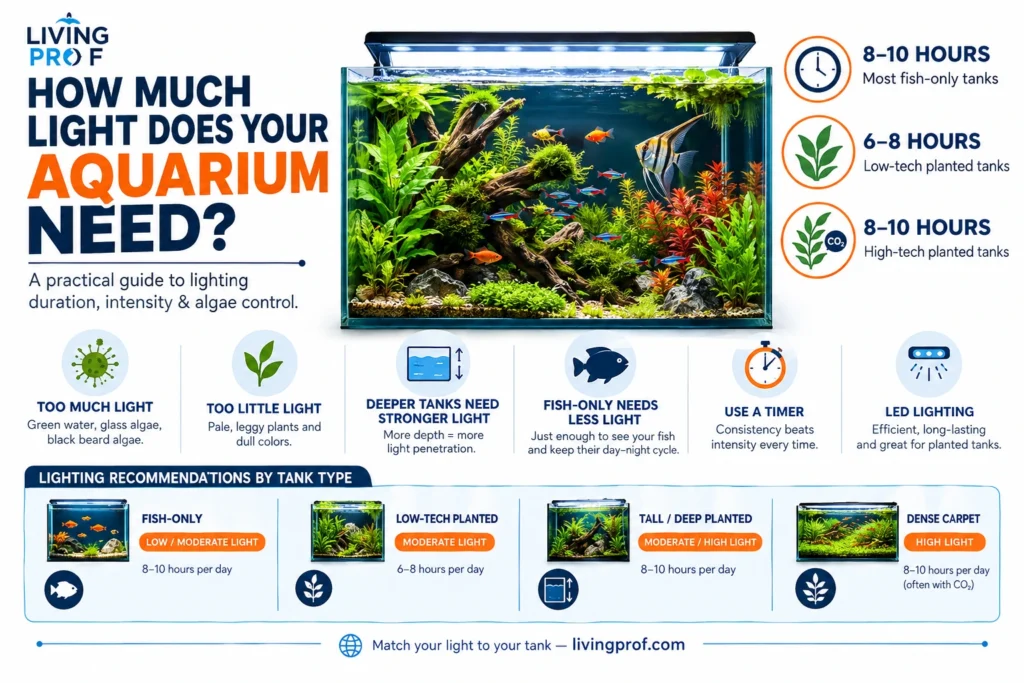
Here’s a rough breakdown that works for most freshwater setups:
- Fish-only tanks: 8–10 hours of light per day
- Low-tech planted tanks (few plants, no CO2): 6–8 hours
- High-tech planted tanks (CO2, ferts, dense growth): 8–10 hours, sometimes split into two blocks
- Breeding tanks for species like guppies: can run slightly longer to encourage feeding activity
Splitting the photoperiod is a trick a lot of planted tank keepers swear by. Instead of one 10-hour block, you run 4 hours, then a 3–4 hour “siesta” where the light is fully off, then another 4 hours. This apparently starves algae of the continuous light it needs to really take hold, while the plants still get their total hours in. Does it work every time? Not always, but I’ve had good results with it on a stubborn green-water tank.
Consistency beats everything else here. Random on-off patterns confuse fish, stress them out, and give algae the unpredictable light bursts it loves. A cheap plug-in timer solves this instantly and costs less than a single bag of fish food.
Signs Your Aquarium Is Getting Too Much Light
Ever walked into the room and thought your tank looked like a swamp overnight? That’s usually too much light, not too little. Algae doesn’t need much of an excuse to take over, and excess light is its favourite excuse.
Watch for these warning signs:
- Green water that turns the whole tank cloudy within days
- Brown or green film coating the glass faster than you can clean it
- Black beard algae creeping onto driftwood and slow-growing plants
- Fish hiding more than usual, especially shy species that prefer shade
- Plant leaves bleaching or developing crispy brown edges near the light source
If two or more of these sound familiar, cut your photoperiod by an hour and see what happens over the next week. Small adjustments work better than panic-fixing everything at once. And no, throwing more fish or a bigger filter at algae doesn’t fix a lighting problem, even though a solid pick from 10 best aquarium filters definitely helps overall water quality.
Signs Your Aquarium Isn’t Getting Enough Light
Underlit tanks are quieter about it, which is honestly what makes them sneaky. There’s no dramatic green explosion, just a slow fade into “meh.”
- Plants grow tall and thin reaching for the light instead of bushing out
- Leaf colour goes pale or washed out, especially on red or purple plant varieties
- New growth is weak and floppy
- The tank just looks flat and grey, even with clean water
- Fish colours seem duller than they should be, particularly on species bred for vibrant patterns
Community tanks built around peaceful freshwater combinations often suffer here because people pick a light based on price, not on what’s actually swimming and growing inside. A tank full of colourful angelfish deserves enough light to actually show off those colours, not a bulb that leaves everything looking beige.
Matching Light Intensity to Tank Size
Bigger tank, more light needed, right? Sort of, but it’s not that simple. Depth matters just as much as surface area, because light has to travel further to reach the substrate in a tall tank than a shallow one.
| Tank Type | Approx. Light Level Needed |
|---|---|
| Shallow fish-only tank (under 40cm deep) | Low to moderate |
| Standard community tank (40–50cm deep) | Moderate |
| Tall planted tank (60cm+ deep) | Moderate to high |
| Dense carpet planted tank | High, often with CO2 support |
Rather than guessing at wattage numbers that vary wildly between brands, run your tank’s exact dimensions through the aquarium lighting calculator. It takes the guesswork out completely, and it’s a lot more reliable than the old “watts per gallon” rule most of us grew up with, which honestly falls apart the second you switch from old-school fluorescent tubes to LEDs.
If you’re not sure what size tank you’re even working with in the first place, the fish tank volume calculator sorts that out in about ten seconds.
LED vs Older Lighting: Does It Change How Much You Need?
Short answer: yes, massively. Old-school fluorescent tubes and modern LED fixtures are not interchangeable watt-for-watt, and comparing them by wattage alone is basically comparing apples to a completely different fruit.
LEDs run cooler, last longer, and push out far more usable light per watt than the tubes most of us grew up with. This means:
- A 20W LED fixture can outperform a 40W fluorescent tube for plant growth
- LEDs generate less heat, so they have a smaller effect on tank temperature (still worth checking with a decent aquarium thermometer though)
- Dimmable LEDs let you fine-tune intensity instead of committing to one fixed brightness
- Full-spectrum LEDs support both plant growth and fish colour far better than older bulbs
If your tank’s still running on whatever came in the starter kit box, it’s worth comparing options properly. The best LED aquarium lights guide breaks down what’s actually worth buying versus what’s just marketing dressed up as a “pro” fixture.
One thing worth remembering: switching from fluorescent to LED often means you need less total wattage, not more, to get the same growth. People upgrade lights and then wonder why algae exploded, and it’s usually because they kept the same 10-hour photoperiod on a fixture that’s suddenly twice as efficient.
Does Every Fish Species Have Different Lighting Needs?
Yes, and this is where a lot of generic advice falls apart. Fish evolved in wildly different environments, and their lighting tolerance reflects that.
- Shade-loving species: Discus and many corydoras come from slow, tannin-rich rivers with dense canopy cover. Bright light stresses them out.
- Moderate light tolerant: Most community species, including guppies and standard tetras, handle typical aquarium lighting just fine.
- Species that appreciate brighter tanks: Fish bred heavily for colour, like show-grade bettas, often look their best under stronger, full-spectrum light.
- Coldwater species: Fish covered in coldwater and subtropical care guides generally do fine with moderate, natural-feeling light rather than intense tropical-style output.
If you’re mixing species with different comfort levels in one tank, add floating plants or driftwood to create shaded pockets. Fish that want to hide from bright light will find their spot, and the ones that don’t mind will still get plenty of open, well-lit swimming space.
Fine-Tuning Light Around Filtration and Heat
Lighting doesn’t exist in isolation. It interacts with water temperature, filtration, and overall tank stability, so tweaking one without considering the others usually backfires.
Strong lighting speeds up algae growth, which puts extra strain on your filter as it deals with the added organic waste. Pairing bright lighting with weak filtration is basically asking for trouble. Check that your setup, whether it’s from the best aquarium filters roundup or something else entirely, can actually keep up with a heavily planted, brightly lit tank.
Heat is the other overlooked factor. Older lighting fixtures can raise water temperature more than people expect, which is why pairing a light upgrade with a reliable aquarium heater and thermometer combo keeps everything stable rather than fighting itself. And if you’re setting up a tank from scratch, the tank capacity and equipment guide walks through how lighting, filtration, and heating all need to work together, not as separate afterthoughts bolted on one at a time.
For a broader look at general fish care once your lighting’s sorted, the aquarium fish hub has guides covering pretty much every popular species, and the tools section has calculators for basically everything else you’ll need to plan a tank properly.
Frequently Asked Questions
How do I know if my aquarium light is too strong? Green water within days, algae film on the glass, and fish hiding more than usual are the clearest signs. Cut the photoperiod by an hour first before assuming you need a whole new fixture.
Can I leave aquarium lights on all day? No. Fish and plants both need a proper dark period. Constant light stresses fish out and gives algae the continuous energy source it thrives on.
Do fish-only tanks need less light than planted tanks? Yes, considerably less. Fish-only tanks mainly need light for visibility and a normal day-night rhythm, while planted tanks need enough intensity to actually drive photosynthesis.
Does tank depth affect how much light I need? Yes. A deeper tank needs stronger light to reach the substrate properly, since light intensity drops off the further it has to travel through water.
Should I turn lights off completely at night? Yes, fully off. Dim night lights sound nice but they can still disrupt natural rhythms for both fish and plants over time.
Is more light always better for plant growth? No. Too much light without enough nutrients or CO2 just fuels algae faster than it fuels your plants, leaving you with a green mess instead of a lush tank.