Why Is A Fish Tank Volume Calculator Essential For Every Aquarist?
Why do you actually need a Fish Tank Volume Calculator? Can’t you just guess based on the box dimensions?
No way! Guessing your water volume is a fast track to disaster in this hobby. When you buy a 55-gallon glass box from the store, that number measures the outside dimensions filled to the absolute brim. You aren’t filling your glass box to the top rim unless you want a flooded living room, right?
Plus, every bucket of gravel, drift wood piece, and rock you toss in pushes water out. Here is what accurate calculations actually impact day-to-day:
- Medication Dosing: Treatments like Praziquantel for fish require exact volume figures so you don’t accidentally poison your livestock.
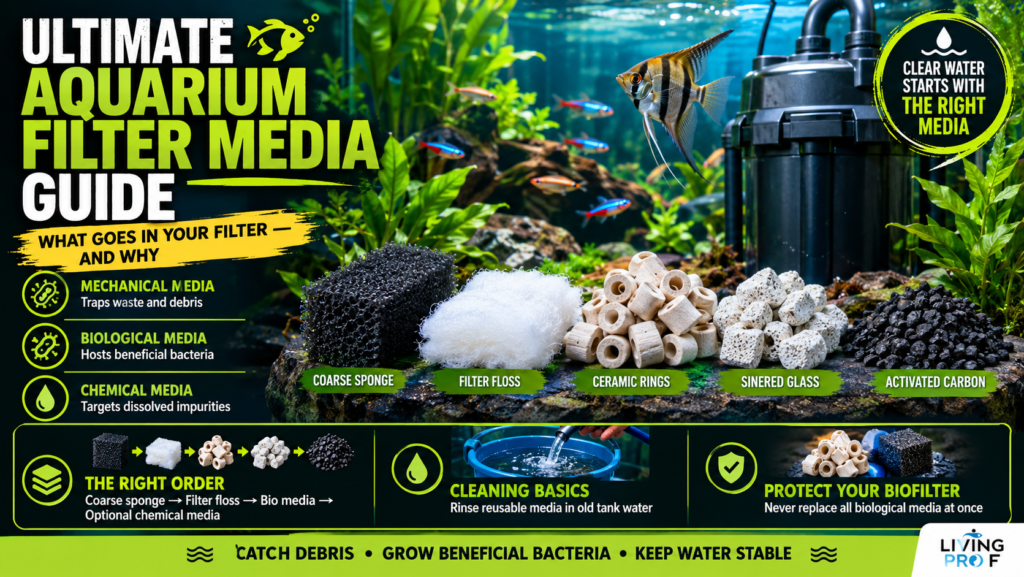
- Filter Selection: Picking the right filter from a roundup of 10 best aquarium filters depends entirely on turning over actual water volume 4 times per hour minimum.
- Heater Sizing: Choosing gear from the 7 best aquarium heaters requires knowing true water mass so your tank doesn’t freeze or boil.
- Stocking Limits: Adding sensitive species like Discus fish or Guppy fish requires strictly calculated room per swim layer.
How Do You Calculate Standard Rectangular Fish Tank Volume?
How do you calculate a standard rectangular tank volume by hand? Is the math actually hard?
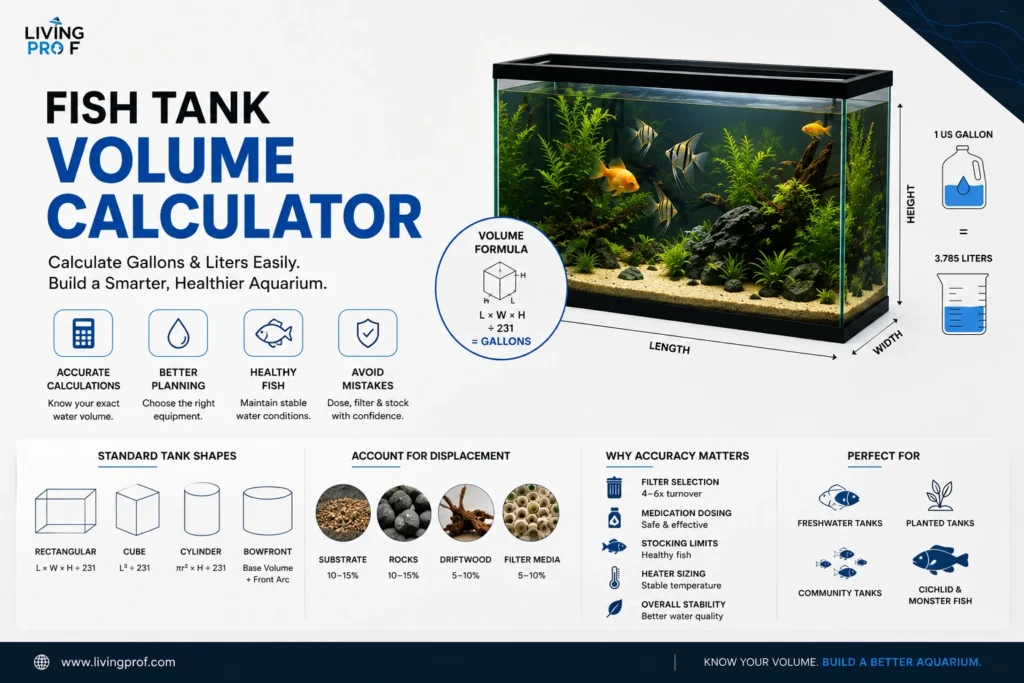
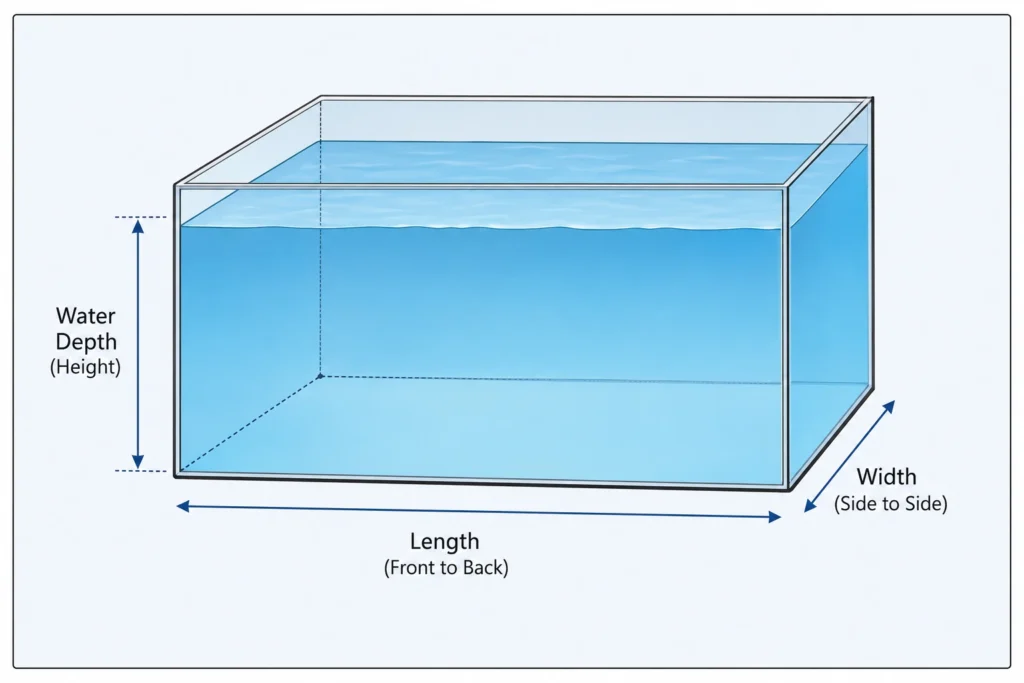
It is super easy! For a basic glass box, you just measure three sides in inches: Length, Width, and Height. Multiply those three numbers together to get cubic inches, then divide by 231. Why 231? Because there are exactly 231 cubic inches in one US liquid gallon!
Let’s break down a quick example using standard dimensions:
Volume (Gallons) = (Length × Width × Height) ÷ 231
Say you have a standard 40-gallon breeder setup measuring 36 inches long, 18 inches wide, and 16 inches tall.
- Multiply 36 × 18 × 16 = 10,368 cubic inches.
- Divide 10,368 ÷ 231 = 44.88 gross US Gallons.
IMO, doing the manual math once helps you spot errors when using online calculators, but holding these numbers in your head is unnecessary when simple web tools exist!
What About Complex Tank Shapes Like Bowfronts, Cubes, And Cylinders?
What if your tank isn’t a plain rectangular box? How do you measure curved glass or bowfront setups?
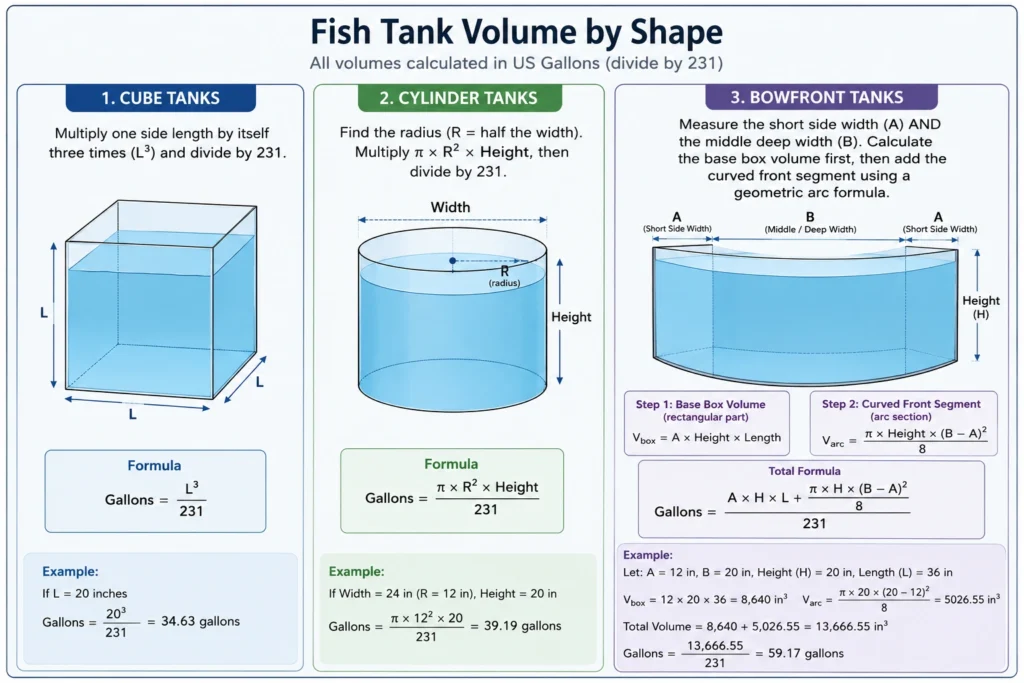
Curved glass makes the math slightly tricky, but you don’t need a math degree to figure it out. Different shapes require specific tweaks to account for structural angles or circular footprints.
- Cube Tanks: Multiply one side length by itself three times (L³) and divide by 231.
- Cylinder Tanks: Find the radius (R = half the width). Multiply π × R² × Height, then divide by 231.
- Bowfront Tanks: Measure the short side width AND the middle deep width. Calculate the base box volume first, then add the curved front segment using a geometric arc formula.
If you’re running complex setups, check our detailed tools section or use our dedicated aquarium lighting calculator to match your exact footprint geometry.
How Much Water Volume Do Substrate, Rocks, And Decor Displace?
How much water volume do you actually lose once you decorate? Does a bag of sand really make that big of a difference?
Yes, it makes a massive difference! I once filled a display tank with 50 pounds of dense seyriu stone and three bags of heavy fluorite sand. When I drained it into measured 5-gallon buckets later on, I discovered I had lost almost 8 gallons of actual swim space!
Here is a quick reference table showing how much water volume you typically lose to common aquascaping materials:
| Hardscape / Media Material | Average Weight Added | Water Volume Displaced |
| Aquarium Sand / Gravel | 20 lbs | ~1.5 Gallons |
| Dense Hardwood / Driftwood | 10 lbs | ~0.8 Gallons |
| Heavy Aquascaping Stones | 25 lbs | ~1.2 Gallons |
| Sump Filter Media | Bulk Bags | ~2.0 Gallons |
As a general rule of thumb, subtract roughly 10% to 15% from your calculated gross volume to find your true “net water volume”.
How Do You Match Tank Volume To Your Fish Species?
How do you know if your calculated volume is actually big enough for the fish you want? Can you just put a small fish in any size tank?
Not if you want them to survive long-term! Different species need specific swimming territory, water parameters, and waste dilution. Putting active swimmers in tight spaces leads to extreme stress, aggressive outbreaks, and premature death.
If you are stocking peaceful social setups, check our guide on the best freshwater community fish combinations to build a balanced community. But if you prefer specialized setups, pay attention to these strict room requirements:
- Dwarf Species: A nano group of Corydoras catfish needs at least 15-20 gallons of footprint space.
- Territorial Cichlids: Tall species like Angelfish require deep tanks over 30 gallons so their long fins don’t drag.
- Monster Predators: Fish like Oscar fish need huge setups. Read up on which food grows monster fish faster before committing to massive 75+ gallon tanks.
- Exotics: True giants require specialized care routines outlined in our monster exotic giant aquarium fish care manual.
What Equipment Depends Directly On Your Actual Water Volume?
What equipment breaks down if your volume calculation is completely off? Is filter size really that picky?
Every electronic device humming away in your stand relies on accurate water numbers! If you buy gear based on raw guesses, you either waste money on underpowered kit or accidentally turn your tank into a washing machine.
       [ Accurate Water Volume Calculation ]
                       │
       ┌───────────────┼───────────────┐
       ▼               ▼               ▼
[ Filter Flow ]  [ Heater Watts ] [ Lighting Units ]
 (4x Turnover)    (5W per Gal)     (PAR & Depth)
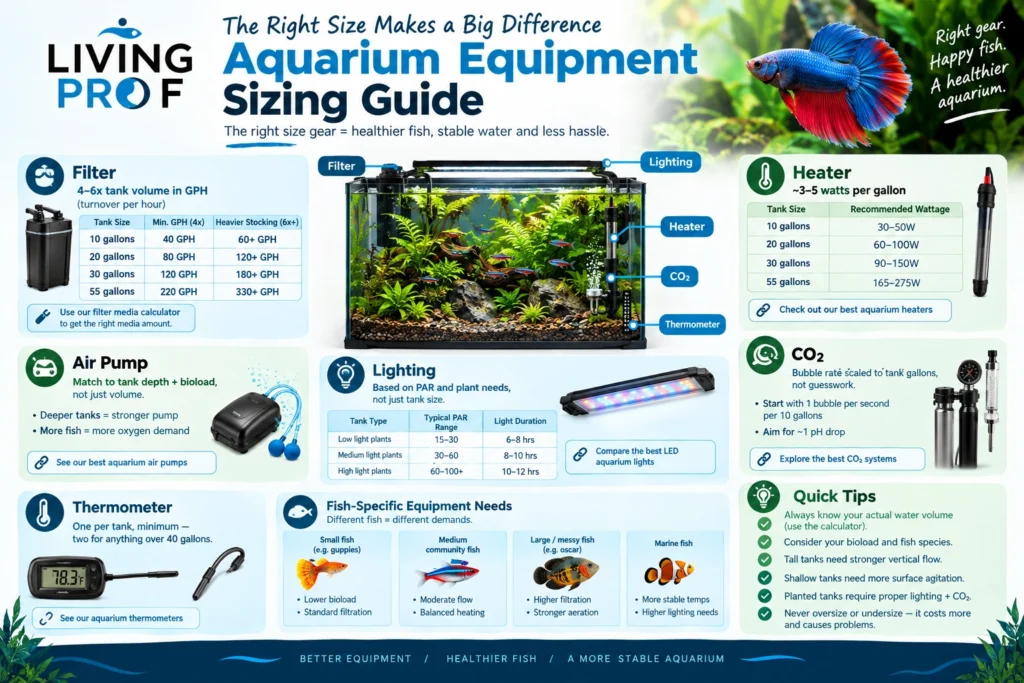
- Filtration Systems: Your filter needs to process your entire net water volume 4 to 6 times every single hour. Check your math before picking equipment from our tank capacity and equipment guide.
- Heater Wattage: You need roughly 3 to 5 watts of power per actual gallon of water to keep temperatures stable.
- Air Pumps: Drive adequate oxygenation using selections from the best aquarium air pumps.
- CO2 Systems: Planted tanks require exact volume figures when setting up the best CO2 systems for planted aquariums.
- Lighting Intensity: Deep tanks cut light penetration fast, so consult our best LED aquarium lights compared 2026 buyers guide to pick proper fixtures.
FYI, running an underpowered filter on a heavily stocked setup is the #1 cause of sudden ammonia spikes!
Frequently Asked Questions
How many gallons is a 30x12x12 inch fish tank?
A 30x12x12 inch fish tank holds approximately 18.7 gross US gallons. Once you account for substrate, decor, and top water margins, it holds roughly 15 to 16 gallons of actual water.
How do I convert aquarium volume from gallons to liters?
Multiply your total US gallon figure by 3.785 to get the equivalent metric liters. For example, a 20-gallon tank equals roughly 75.7 liters.
Why does my fish tank hold less water than the manufacturer label says?
Manufacturer labels list the total external volume of the empty glass box filled to the very top edge. Substrate, rocks, driftwood, filters, and top water gaps reduce your actual liquid capacity by 10% to 15%.
How many fish can I safely put in my tank based on volume?
The old “one inch of fish per gallon” rule is outdated and dangerous! Stocking depends on fish bio-load, adult size, activity levels, and surface area rather than simple water volume alone.