Why Getting Your Tank Volume Right Actually Matters
You’d be surprised how many fishkeepers guess their tank volume. They look at the tank, think “yeah, that’s about 100 litres” and call it a day. Then they wonder why their medication didn’t work, or why their filter is struggling, or why their fish keep getting sick.
Getting your tank volume wrong has real consequences. Underdosing medication means it does nothing — and that’s actually how ich resistance develops. Overdosing can straight up kill your fish. Neither is a good time.
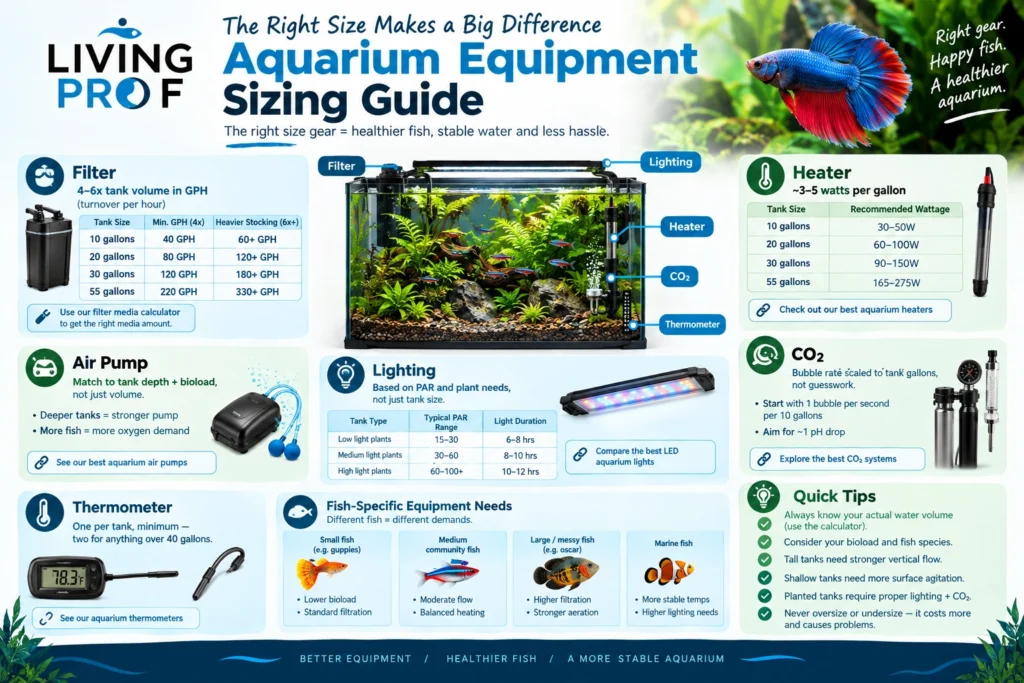
Volume also drives every other equipment decision you make. Your aquarium filter needs to turn over the tank volume roughly 4–6 times per hour. Your aquarium heater is rated in watts per litre. Even your CO2 system needs an accurate volume to dial in the right bubble rate. Everything connects back to this one number — so you want to get it right.
I’ve had tanks where I’ve trusted the manufacturer’s stated volume and got it wrong by nearly 20%. That doesn’t sound like much until you’re medicating for ich and wondering why three rounds of treatment aren’t working.
The Basic Formula for Rectangular Tanks
Most home aquariums are rectangular, which makes volume calculation pretty straightforward. You just need a tape measure and about two minutes.
The Formula
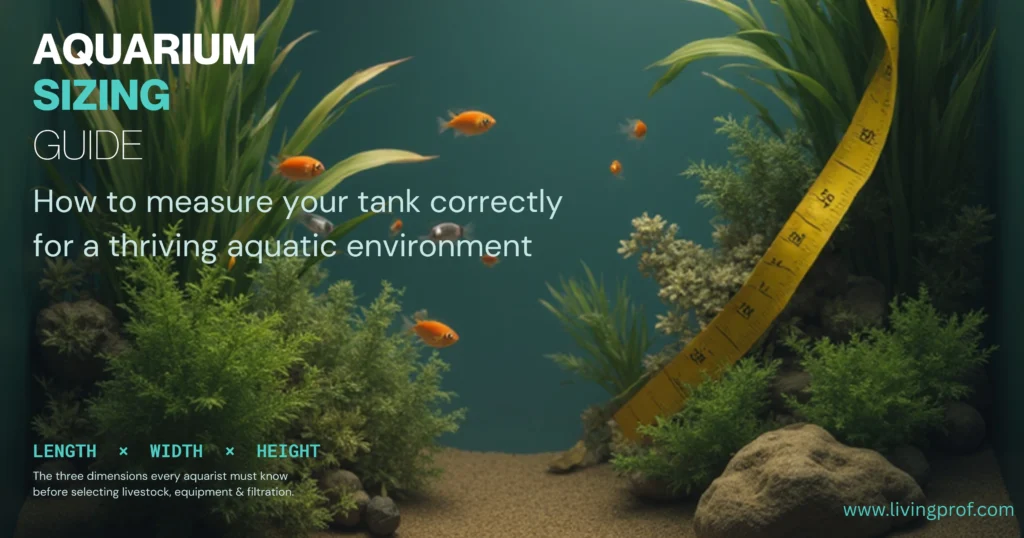
Volume (litres) = Length (cm) × Width (cm) × Height (cm) ÷ 1000
Volume (US gallons) = Length (cm) × Width (cm) × Height (cm) ÷ 3785
Volume (UK gallons) = Length (cm) × Width (cm) × Height (cm) ÷ 4546
Or if you prefer working in inches:
Volume (US gallons) = Length (in) × Width (in) × Height (in) ÷ 231
Example
Say your tank measures 90cm long × 40cm wide × 45cm tall:
90 × 40 × 45 = 162,000 ÷ 1000 = 162 litres
Simple. But here’s the thing — that’s the gross volume. Your actual water volume is lower once you account for substrate, equipment, and the fact that you don’t fill tanks to the very brim.
A good rule of thumb: subtract 10–15% from gross volume to get a realistic net water volume for dosing purposes.
How Tank Shape Changes Everything
Rectangular tanks are easy. The problems start when you’ve got something more interesting — a bow-front, a cylinder, a hexagon, or one of those odd corner tanks. Each shape needs a different approach.
Cylinder Tanks
Volume (litres) = π × radius² × height ÷ 1000
Where radius = diameter ÷ 2. So a cylinder tank that’s 40cm in diameter and 60cm tall:
π (3.14159) × 20² × 60 = 75,398 ÷ 1000 = 75.4 litres
Bow-Front Tanks
These are trickier because of the curved front panel. The rough method is to calculate it as a rectangle first, then add approximately 10–15% for the bow. For accuracy, most people use the fish tank volume calculator which handles bow-fronts properly.
Hexagonal Tanks
Volume (litres) = 2.598 × side length² × height ÷ 1000
L-Shaped or Custom Tanks
Break them into sections. Calculate each rectangular section separately, then add the volumes together. Measure each section at its actual dimensions, not estimates.
| Tank Shape | Formula Complexity | Accuracy Risk if Guessed |
|---|---|---|
| Rectangular | Low | Low |
| Bow-front | Medium | Medium |
| Cylinder | Medium | High |
| Hexagonal | Medium | High |
| L-shaped / custom | High | Very High |
Gross Volume vs Net Volume: Know the Difference
This is something a lot of beginners don’t think about, and it genuinely matters. The number on the tank box is the gross volume — the total internal space assuming it’s filled to the top with nothing in it. Your actual usable water volume (net volume) is always lower.
Here’s what eats into your gross volume:
- Substrate — gravel, sand, or soil can displace 5–20 litres depending on depth and tank size. A 5cm deep gravel bed in a 90cm × 40cm tank displaces around 18 litres alone
- Hardscape — rocks and driftwood are surprisingly heavy water displacers. A decent-sized piece of rock can take out 3–5 litres easily
- Equipment — internal filters, heaters, and powerheads all sit in the water column
- Headspace — most tanks run 2–5cm below the rim, which cuts volume further
- Plants and decor — less significant but still worth noting in heavily planted setups
For most tanks, net volume runs about 80–90% of gross volume. So a tank rated at 200 litres probably holds around 165–175 litres of actual water. Always use net volume when calculating medication doses or fertiliser amounts.
This is especially important if you keep fish with specific requirements — discus fish for example need heavily planted, well-filtered tanks where the effective water volume can differ significantly from the tank rating.
Using the LivingProf Tank Volume Calculator
Look, you can do all the maths manually. But if you’ve got a bow-front tank, an oddly shaped setup, or you just don’t trust your own arithmetic at 11pm when you’re medicating a sick fish — just use a calculator.
The fish tank volume calculator at LivingProf handles multiple tank shapes, converts between litres and gallons automatically, and lets you adjust for substrate depth. It takes about 30 seconds and removes any doubt.
There’s also a tank capacity and equipment guide that matches your volume to the right equipment specs — filtration turnover rates, heater wattage, and stocking guidance all in one place. FYI, this is the kind of tool I genuinely wish existed when I first started keeping fish. Would have saved me from buying an undersized filter for a 180 litre tank and wondering why my water was always cloudy.
The filter media calculator is also worth bookmarking — once you know your actual water volume, it tells you exactly how much biological and mechanical media you need. No more guessing.
How Volume Affects Stocking, Filtration, and Equipment
Volume isn’t just a number you need for medicating. It drives almost every practical decision in fishkeeping. Here’s how it plays out in real terms:
Stocking Levels
The old “1 inch of fish per gallon” rule is outdated and honestly pretty useless for larger or messier fish. But volume still underpins stocking decisions. The general principle: more water = more dilution of waste = more stable water parameters.
- Guppies can work in 40+ litre tanks but thrive with more space
- Betta fish need a minimum of 20 litres — smaller tanks cause temperature instability and water quality crashes
- Oscar fish need 200+ litres per fish — people massively underestimate this
- Angelfish need tall tanks of at least 100 litres given their body shape
- Corydoras do best in groups of 6+ in 80+ litre tanks
Filtration
Your filter needs to process the full water volume 4–6x per hour. So a 150 litre tank needs a filter rated for at least 600 litres per hour. Get this wrong and you get ammonia spikes, murky water, and sick fish — all preventable with accurate volume data.
Heating
Heater sizing goes by roughly 1 watt per litre for tropical tanks in average room temperatures. Cooler rooms or larger tanks need more. A 200 litre tank in a cool room needs a 250–300W heater, not the 100W one that “seemed fine.”
Aquarium Lighting
Light intensity requirements scale with tank depth. Knowing your volume and dimensions helps you pick the right light output for your plants or coral — the aquarium lighting calculator makes this easy.
Common Mistakes People Make When Calculating Tank Volume
I’ve made most of these myself at some point, so no judgement here :/
1. Trusting the manufacturer’s stated volume Manufacturers measure gross volume from the outside of the glass. The internal volume is always smaller due to glass thickness — typically 5–10mm per pane on larger tanks. On a big tank, that can be 5–8 litres difference.
2. Measuring the outside of the tank Always measure the internal dimensions. Glass panels have thickness. Measure from the inside bottom to the waterline, and between the inner faces of the side panels.
3. Ignoring substrate depth A 10cm deep substrate bed in a 120cm × 45cm tank displaces roughly 54 litres. That’s a lot of “missing” volume if you’re calculating medication doses.
4. Forgetting the fill level Tanks rarely run to the top. Most people leave 3–5cm of headspace. Factor this into your height measurement.
5. Using the wrong unit conversion US gallons and UK gallons are not the same. 1 US gallon = 3.785 litres. 1 UK gallon = 4.546 litres. If you’re buying American medication and working in UK gallons you’ll get your doses wrong.
6. Calculating once and never updating Added a big piece of rock? Deepened your substrate? Installed a large internal filter? All of these change your net volume. Recalculate when your tank setup changes significantly.
Putting It All Together: A Practical Workflow
Here’s how to actually do this properly, start to finish:
- Measure internal dimensions — length, width, and water depth (not tank height) in centimetres
- Calculate gross volume using the appropriate formula for your tank shape
- Subtract for substrate — measure substrate depth, calculate its volume (L × W × substrate depth ÷ 1000), and subtract
- Subtract roughly 5% for hardscape, equipment, and headspace
- That’s your net volume — use this for all dosing, stocking, and equipment decisions
- Cross-check with the tank volume calculator — takes 30 seconds and confirms your maths
Keep this number written down somewhere. Stick a piece of tape on the back of the tank with the volume on it if you need to. Future you — standing at the tank at midnight trying to dose for ich — will be very grateful.
If you’re building out a full setup and want to match your volume to the right equipment specs, the tools section at LivingProf has calculators for lighting, filtration media, and tank capacity all in one place. Worth a bookmark.
Frequently Asked Questions
Does the volume on the tank box match the actual water volume? No. The stated volume is gross volume measured from external dimensions. Your actual water volume is always lower — usually 10–20% less once you account for glass thickness, substrate, and equipment.
How do I calculate volume for a tank with a sloped bottom? Treat it as two sections — a rectangular section at the base (using the shallower depth) and a triangular prism for the sloped portion. Add them together. Or just use the calculator.
Does the type of substrate affect volume calculations? Yes. Gravel, sand, and soil all displace different amounts based on particle density, but for practical purposes you calculate substrate displacement by its physical dimensions (L × W × depth), not by weight.
How accurate does my volume need to be for medication dosing? Within 10% is generally fine for most treatments. For copper-based medications especially, accuracy matters more — copper has a narrow therapeutic window and you don’t want to be significantly off in either direction.
My tank is second-hand and has no model number — how do I find the volume? Measure the internal dimensions yourself. Don’t estimate based on what it “looks like.” A tape measure inside the tank takes two minutes and is always more reliable than guessing.
Does a heavily planted tank have significantly less water volume? Plants themselves displace very little water — the main volume loss in planted tanks is usually from thick substrate layers (often 7–10cm in planted setups) and hardscape. Factor these in as normal.
Do I use gross or net volume for filter sizing? Use gross volume for filter sizing. Filters are rated for the full tank size, and a slightly oversized filter is never a problem. Under-filtration is the issue you want to avoid.
What’s the easiest way to convert litres to US gallons? Divide litres by 3.785. So 150 litres ÷ 3.785 = approximately 39.6 US gallons. Or just use the fish tank volume calculator which does the conversion automatically.
Does tank volume matter for a community fish setup? Absolutely — it’s one of the most important factors. More water volume means more stable water parameters, which is critical in a community tank where multiple species have different needs. More volume also gives you more buffer time if something goes wrong.
How often should I recalculate my tank volume? Recalculate any time you make significant changes to substrate depth or add large hardscape pieces. Otherwise, once you have an accurate figure, it stays the same.