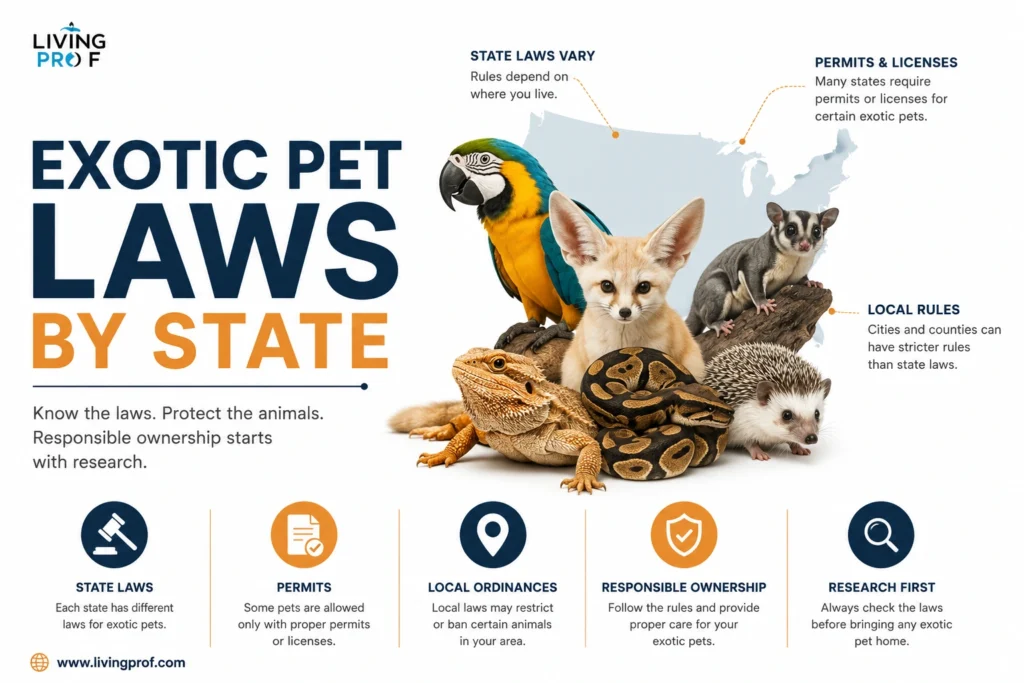
Thinking about getting an exotic pet? Before you buy the enclosure, find a breeder, or fall for a ridiculously cute animal video, check the law first. A pet that is perfectly legal in one state can be restricted, permit-only, or completely banned somewhere else.
That is where things get a little messy. There isn’t one simple U.S. rule that tells you which exotic animals you can keep. States create their own wildlife laws, and cities and counties can add another layer of restrictions. So yes, your state might say “legal” while your city says “absolutely not.” Fun, right?
Key Takeaways
| What you want to know | Quick answer |
|---|---|
| Are exotic pets legal in every state? | No. Rules vary widely by animal and location. |
| Do all states use the same definition of an exotic pet? | No. States classify animals differently. |
| Can a legal exotic pet require a permit? | Yes. Many states use permits, licenses, registration, or certificates. |
| Can my city have stricter rules than my state? | Yes. Local rules can be stricter than state law. |
| Are all reptiles legal? | No. Some states restrict particular reptiles or dangerous species. |
| Are monkeys legal as pets? | Only in some states, and several states prohibit or heavily restrict them. |
| Are ferrets legal? | In most states, yes, but California and Hawaii ban them statewide, while New Jersey and Rhode Island require permits. |
| Can I buy an exotic pet first and get a permit later? | You should not assume that. Some permits apply only to certain situations or existing animals. |
The safest approach is simple: identify the exact species, check your state wildlife rules, then check your county and city rules before acquiring the animal.
What Counts as an Exotic Pet?
“Exotic pet” sounds straightforward until you start looking at actual laws. A state may treat a ferret differently from a wild mustelid, a captive-bred reptile differently from a native wild animal, and a small monkey differently from a dangerous primate. The legal category matters more than the everyday name people use for the animal.
For example, people often put ferrets, hedgehogs, sugar gliders, reptiles, amphibians, parrots, monkeys, foxes, raccoons, and skunks under the broad exotic-pet label. Legally, those animals can fall under completely different rules.
That difference matters if you are researching a new pet. Searching “Are exotic pets legal in my state?” gives you a general answer, but it may not answer the question you actually need. The better question is, “Can I legally keep this exact species at my address?”
Common animals people check before buying
- Ferrets
- Hedgehogs
- Sugar gliders
- Snakes
- Lizards
- Turtles and tortoises
- Exotic frogs
- Axolotls
- Skunks
- Raccoons
- Fennec foxes
- Capybaras
- Monkeys and other primates
- Large constrictors
- Wild cats
- Other carnivores
The legal difference can be surprisingly specific. Current statute-based research, for example, shows that ferrets have a much easier legal path in many states than raccoons. Ferrets are legal at the state level in 46 states plus Washington, D.C., while raccoons face bans in many states and permit requirements in others.
So don’t treat “exotic pet” as one legal category. The species comes first.
How Exotic Pet Laws Work Across the United States
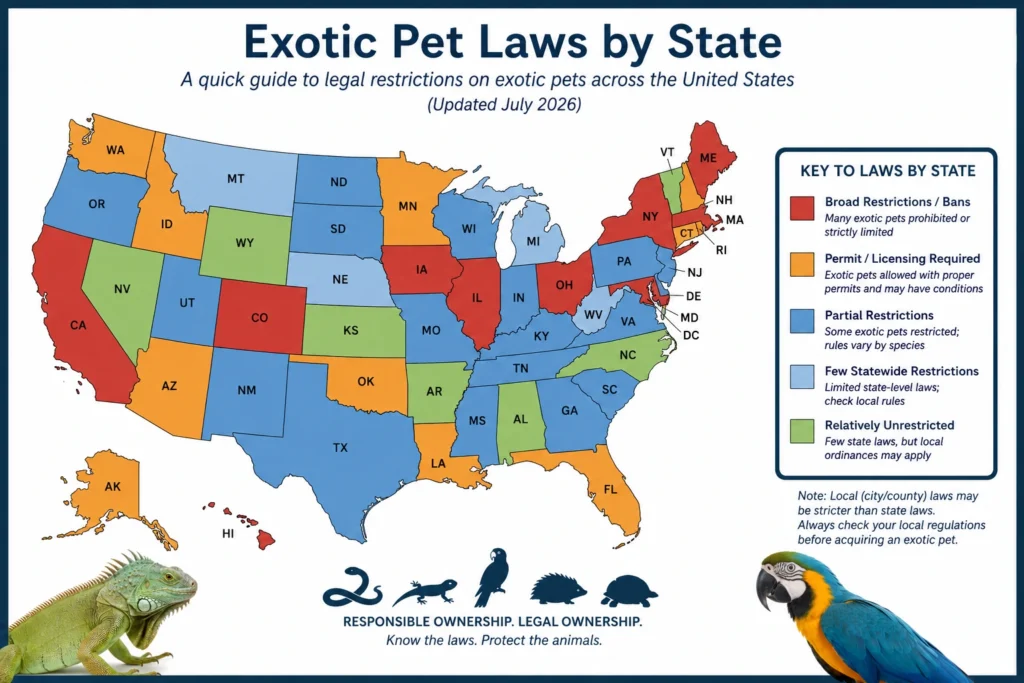
There is no single nationwide list of every animal that Americans can keep as pets. Instead, several layers of law can affect ownership.
At the state level, lawmakers may create prohibited-species lists, licensing systems, dangerous-animal rules, wildlife regulations, or exemptions for domesticated species. Some states focus heavily on dangerous animals, while others regulate a much wider range of non-native species.
Current state comparisons commonly group laws into four broad patterns:
- No broad statewide ban
- Partial bans
- Licensing or permit systems
- Broad or comprehensive restrictions
World Population Review’s 2026 state comparison uses those same broad categories and notes that exotic-animal rules can be species-specific and can change over time.
Why the same animal can have different rules
Imagine two people buy the same species.
Person A lives in a state where the animal does not require a state permit.
Person B lives across the state line, where the same species requires a wildlife permit, proof of suitable housing, or other conditions.
The animal didn’t change. The law did.
That is why online lists can sometimes cause problems. A website may say an animal is “legal in the U.S.” while quietly ignoring the fact that several states ban it and other states require permits.
The safest way to read these rules is to look for three things:
- Species: What exact animal are you keeping?
- Location: What state, county, and city do you live in?
- Purpose: Are you keeping it as a pet, breeding it, exhibiting it, selling it, or transporting it?
That last point gets overlooked a lot. A rule that applies to an ordinary pet owner may not apply in the same way to a zoo, breeder, educational facility, wildlife rehabilitator, or licensed exhibitor.
Exotic Pet Laws by State
The table below gives a practical starting point for all 50 states. It does not mean every animal in a “permissive” state is legal. Think of it as the first filter, not the final legal answer.
| State | General approach | What to check |
|---|---|---|
| Alabama | Limited statewide restriction | Species-specific and local rules |
| Alaska | Partial restrictions | Restricted wildlife lists and permits |
| Arizona | Licensing/restricted wildlife system | Species classification |
| Arkansas | Partial restrictions | Captive wildlife rules |
| California | Very restrictive | Restricted-species list and local rules |
| Colorado | Broad restrictions | Wildlife classifications and exemptions |
| Connecticut | Partial restrictions | Wildlife permits and prohibited species |
| Delaware | Licensing system | Exotic animal permits |
| Florida | Tiered regulation | Class I, II and III wildlife rules |
| Georgia | Broad restrictions | Wild-animal licensing and prohibited species |
| Hawaii | Very restrictive | Wildlife and ecosystem protections |
| Idaho | Licensing/restricted-species rules | Species-specific requirements |
| Illinois | Broad restrictions | State and municipal rules |
| Indiana | Licensing system | Wild-animal permits |
| Iowa | Broad restrictions | Dangerous-animal rules |
| Kansas | Relatively limited statewide restrictions | Local ordinances and species rules |
| Kentucky | Broad restrictions | Wildlife regulations |
| Louisiana | Partial restrictions | Dangerous/exotic animal classifications |
| Maine | Licensing system | Wildlife permit requirements |
| Maryland | Broad restrictions | Prohibited species and local rules |
| Massachusetts | Broad restrictions | Wildlife possession rules |
| Michigan | Partial restrictions | Species and permit requirements |
| Minnesota | Partial restrictions | Wild-animal regulations |
| Mississippi | Licensing system | Wildlife permits and insurance |
| Missouri | Licensing/restriction system | County and state requirements |
| Montana | Licensing system | Species-specific rules |
| Nebraska | Partial restrictions | Captive wildlife regulations |
| Nevada | Limited statewide restrictions | County and city ordinances |
| New Hampshire | Broad restrictions | Wildlife permits |
| New Jersey | Licensing/permit system | Exotic and potentially dangerous species |
| New Mexico | Broad restrictions | Wildlife classification |
| New York | Broad restrictions | State rules plus local laws |
| North Carolina | Limited statewide regulation | County rules are especially important |
| North Dakota | Licensing system | Wildlife permits |
| Ohio | Broad restrictions | Dangerous wild animal regulations |
| Oklahoma | Licensing/restricted species rules | Wildlife requirements |
| Oregon | Broad restrictions | Wildlife possession rules |
| Pennsylvania | Licensing/restriction system | Exotic wildlife permits |
| Rhode Island | Licensing system | Species-specific permits |
| South Carolina | Broad restrictions | State wildlife rules |
| South Dakota | Licensing system | Wildlife permits |
| Tennessee | Partial restrictions | Wildlife classification |
| Texas | Licensing/registration system | Dangerous wild animal rules |
| Utah | Broad restrictions | Restricted wildlife permits |
| Vermont | Broad restrictions | Wildlife possession rules |
| Virginia | Partial restrictions | Wildlife regulations and local laws |
| Washington | Broad restrictions | Prohibited wildlife list |
| West Virginia | Partial restrictions | Wildlife permits |
| Wisconsin | Licensing/restriction system | Species and local rules |
| Wyoming | Partial restrictions | Wildlife regulations |
This broad state classification comes from current 2026 state-level comparisons. It should not replace a species-specific legal check because states can place very different rules on individual animals.
States that deserve extra caution
California and Hawaii stand out for their strict approach to many exotic pets. California, for example, prohibits several animals that people commonly assume they can keep, including ferrets, hedgehogs, sugar gliders, and axolotls.
At the other end, states such as Alabama, Nevada, and North Carolina have comparatively limited statewide restrictions, but that does not mean every exotic animal is automatically legal. Local rules and species-specific regulations still matter.
And then you have states with detailed licensing systems. Florida, Texas, Pennsylvania, Indiana, and several others can require permits, registration, or other conditions depending on the animal.
So, yes, the state matters. But the animal matters just as much.
Which Exotic Pets Are Commonly Legal?
Some exotic pets have much simpler legal rules than others.
Small captive-bred mammals, common reptiles, amphibians, and ornamental fish often have fewer restrictions than large carnivores or primates. Even then, exceptions appear quickly.
Ferrets
Ferrets provide a good example of why broad statements can be misleading.
As of July 2026, ferrets are legal at the state level in 46 states and Washington, D.C. California and Hawaii prohibit them statewide, while New Jersey and Rhode Island require permits. New York State allows them, but New York City prohibits them.
That is one animal with several different answers depending on where you live.
Hedgehogs
Hedgehogs also show how state laws can differ. Current research identifies California, Georgia, Hawaii, Pennsylvania, and Washington, D.C. as places where pet hedgehogs are prohibited, with New Jersey using a permit system.
Reptiles
Reptile rules can get much more complicated.
A small captive-bred gecko may have very different legal treatment from a large constrictor or venomous snake. Native species can also trigger wildlife rules that do not apply to common captive-bred species.
If reptiles are your thing, it helps to separate the question into:
- Nonvenomous snakes
- Large constrictors
- Venomous snakes
- Lizards
- Turtles and tortoises
- Native reptiles
- Non-native reptiles
For example, someone considering a leopard gecko should not assume the rules for a venomous snake apply to it. The same goes for a ball python, corn snake, or bearded dragon.
If you’re choosing a reptile, our corn snake care guide and ball python care guide can help with the husbandry side once you’ve confirmed the legal side.
Primates, Raccoons, Skunks and Other Difficult Cases
This is where exotic pet law gets serious.
Primates, raccoons, skunks, wild cats, bears, and other wildlife often face much tighter restrictions than common captive-bred pets. Some states ban private possession outright. Others use permits, registration, insurance, enclosure requirements, or grandfathering provisions.
Take monkeys as an example. Current state-by-state research shows a mixture of outright bans, permit systems, limited species exceptions, and states where local governments play a major role.
Raccoons are even more restrictive. A current 2026 statute-based review found that pet raccoons are banned in 34 states plus Washington, D.C., permit-only in 14 states, and freely legal at the state level only in Arkansas.
Skunks also create unusual legal questions because wildlife rules and rabies regulations can overlap. A state may allow possession while placing restrictions on transport, vaccination, sale, or what happens if the animal bites someone.
Why dangerous animals receive stricter treatment
The law generally becomes tougher when an animal creates a greater risk to:
- Public safety
- Native wildlife
- Agriculture
- Disease control
- Animal welfare
- Emergency responders
That explains why a state may tolerate a small captive-bred reptile while prohibiting a tiger or chimpanzee.
The federal government also regulates some animal-related activities. For example, USDA APHIS administers the Animal Welfare Act, which can apply to certain dealers, exhibitors, transporters, and other regulated activities. A private person keeping animals solely for personal enjoyment may fall outside licensing requirements, but the exact activity matters.
So don’t confuse “not federally licensed” with “legal everywhere.” Those are very different statements.
Permits, Licenses and Registration: What Do They Actually Mean?
A permit does not always mean the state welcomes the animal as a normal household pet.
Sometimes a permit allows possession after you meet specific conditions. Those conditions can include enclosure standards, inspections, proof of experience, liability insurance, registration, fees, or documentation showing where the animal came from.
Other permits exist mainly for zoos, educational facilities, breeders, exhibitors, researchers, or wildlife professionals.
This distinction matters a lot.
Imagine finding a page that says, “Permits are available for monkeys in State X.” That sounds encouraging. But if the permit only applies to licensed exhibitors or accredited facilities, it does not give an ordinary pet owner a legal route.
Current statute-based research specifically warns against treating a permit category as automatic permission for private pet ownership.
Before applying for a permit, check:
- Who can apply?
- Does the permit allow personal pet ownership?
- Does the animal need to come from a legal source?
- Does the enclosure need inspection?
- Do you need liability insurance?
- Does the permit cover breeding?
- Can you transport the animal across state lines?
- Does your county or city also require approval?
- What happens if you move?
- What happens to the animal if the permit expires?
That last question gets ignored far too often.
A permit is not just a piece of paper you get once and forget about. Some permits involve renewals and continuing conditions.
And if you’re moving between states, don’t assume your existing permit travels with you. State animal-entry requirements are maintained by the receiving state or territory, according to USDA APHIS.
City and County Laws Can Change the Answer
This might be the most frustrating part of exotic pet ownership.
You can check your state’s law, find that your animal is allowed, and still run into a local ban.
New York provides a clear example. Ferrets are legal under New York State rules, but New York City prohibits them within its five boroughs.
North Carolina creates another interesting situation. The state has comparatively limited statewide restrictions on some exotic animals, but counties can create their own rules. Current research specifically flags county-level regulation for monkeys.
So your research should follow this order:
State → County → City → Animal-specific rules → Permit requirements
Don’t stop after the first result on Google.
What local authorities may regulate
Local governments can address:
- Dangerous animals
- Zoning
- Minimum enclosure standards
- Noise
- Sanitation
- Number of animals
- Residential ownership
- Animal nuisances
- Public safety
- Special permits
This matters especially if you live in an apartment, townhouse, or densely populated neighborhood. Even where wildlife law allows the animal, zoning rules may create another problem.
Before bringing an exotic animal home, call the relevant local authority and ask about the exact species, not just “exotic pets.”
Write down the answer.
Honestly, this takes five minutes and can save you a huge headache later.
How to Check If an Exotic Pet Is Legal Before You Buy
If you have found an animal you really want, don’t start with the breeder. Start with the law.
Here is the process I would use.
Step 1: Identify the exact species
Get the scientific name if possible.
“Snake” is too vague.
“Fox” is too vague.
“Monkey” is very, very vague.
The scientific name can make it much easier to find the correct regulation.
Step 2: Check your state wildlife agency
Look for terms such as:
- Exotic animals
- Captive wildlife
- Restricted wildlife
- Wild animals
- Possession permit
- Prohibited species
- Dangerous animals
State wildlife agencies and state agriculture departments often provide the most useful starting points.
Step 3: Check local rules
Contact your county and city.
Ask whether the species is allowed at a private residence.
Step 4: Check transport and import rules
If you are buying the animal from another state, check the receiving state’s animal-entry requirements. USDA APHIS notes that each state or territory maintains its own requirements for incoming live animals.
Step 5: Check the permit before paying a deposit
Do not assume a breeder’s statement counts as legal approval.
Ask for the relevant regulation and verify it yourself.
Step 6: Keep records
Keep copies of:
- Permit
- Registration
- Purchase records
- Captive-bred documentation
- Veterinary records
- Import documents
- Identification records
If an official ever asks where the animal came from, good records make the conversation much easier.
And yes, I would keep digital copies too. Phones fail, paperwork disappears, and suddenly that one document you thought you’d never need becomes very interesting.
Frequently Asked Questions About Exotic Pet Laws
What state has the least restrictive exotic pet laws?
There is no single answer for every species. Current state comparisons identify Alabama, Nevada, and North Carolina as states with comparatively limited statewide restrictions, but individual animals can still face restrictions and local governments can add their own rules.
What states ban the most exotic pets?
California and Hawaii are among the most restrictive states. California, for example, prohibits several popular exotic pets, including ferrets, hedgehogs, sugar gliders, and axolotls.
Are ferrets legal in the United States?
Ferrets are legal at the state level in most of the country. Current 2026 research lists them as legal in 46 states and Washington, D.C., with statewide bans in California and Hawaii and permit requirements in New Jersey and Rhode Island. New York City also bans them.
Can I own a monkey as a pet?
It depends on the state and species. Some states prohibit private primate ownership, while others allow particular species or require permits. A permit for an institution or exhibitor does not necessarily create a legal route for an ordinary pet owner.
Can I own a raccoon?
Raccoons face significant restrictions. Current 2026 research lists them as banned in 34 states plus Washington, D.C., permit-only in 14 states, and legal without a state permit in Arkansas.
Are exotic reptiles legal everywhere?
No. Reptile laws vary by species. Common captive-bred reptiles may have fewer restrictions, while venomous snakes, large constrictors, native species, or other regulated reptiles can require permits or face bans.
Can my city ban an animal that my state allows?
Yes. Local governments can impose stricter rules than the state. New York City’s ferret ban is a clear example of a local rule overriding what is otherwise legal under state law.
Should I trust a breeder who says an exotic pet is legal?
Treat the breeder’s answer as a starting point, not legal confirmation. Check the current state regulation and local ordinance yourself before paying for the animal.
Can exotic pet laws change?
Yes. Wildlife regulations can change through legislation, agency rules, court decisions, or local ordinances. Current legal databases also warn that their information should be treated as informational rather than legal advice.
Final Thoughts
Finding a legal exotic pet isn’t just about asking whether your state “allows exotic animals.” That question is too broad to be useful.
The real question is much more specific: Is this exact species legal for me to keep at my particular address, under the current state and local rules?
Check the species. Check the state. Check the county. Check the city. Then check permits and transport requirements.
If you’re choosing a reptile, you can also use our reptile care resources before bringing the animal home. For aquarium species, our aquarium fish guides cover everything from basic care to more specialized species.
And if you are still deciding which exotic pet makes sense for you, don’t rush it. The coolest animal on the internet isn’t necessarily the right animal for your home—or a legal one for that matter.
Check the law first. Buy the animal second.