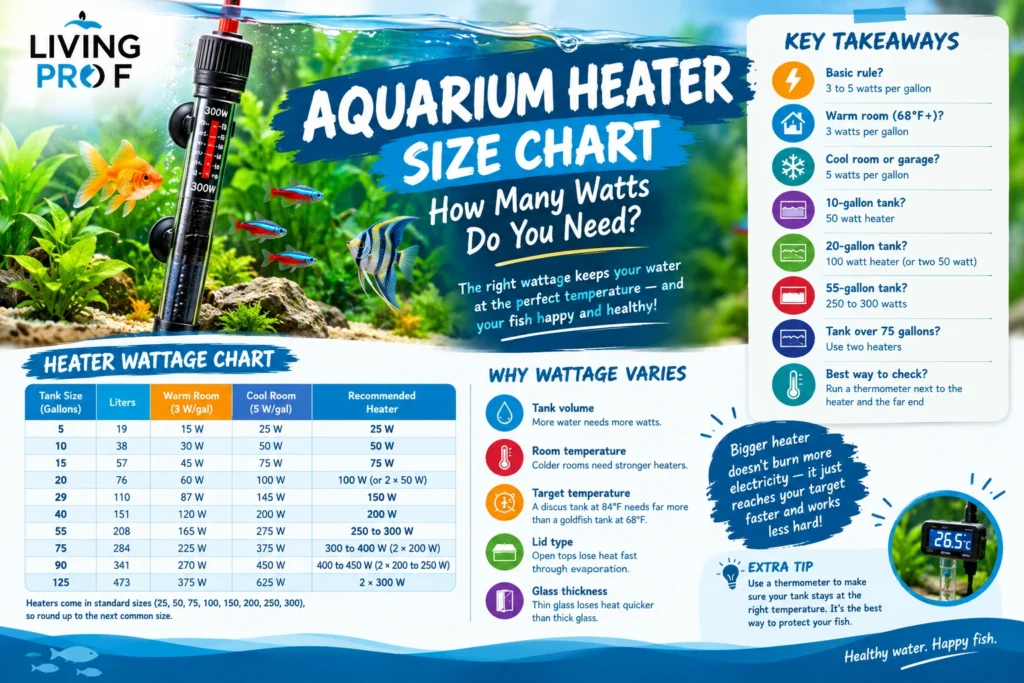
Your heater is too small, and you probably don’t know it yet. I’ve seen tanks sit at 72°F all winter while the owner swears the heater “works fine.” The fish disagree, and they tell you by getting sick.This guide gives you the chart, the math, and the mistakes I see most. You’ll know your wattage in about two minutes.
Key Takeaways
| Question | Short Answer |
|---|---|
| Basic rule? | 3 to 5 watts per gallon |
| Warm room (68°F+)? | 3 watts per gallon is usually enough |
| Cool room or garage? | 5 watts per gallon |
| 10-gallon tank? | 50 watt heater |
| 20-gallon tank? | 100 watt heater (or two 50 watt) |
| 55-gallon tank? | 250 to 300 watts |
| Tank over 75 gallons? | Use two heaters |
| Best way to check? | Run a thermometer next to the heater and the far end |
How Many Watts Does Your Aquarium Heater Need?
Most tanks need 3 to 5 watts for every gallon of water. That’s the whole rule. Everything else in this article just helps you pick the right number inside that range.
Why such a wide range? Your room decides. A tank in a warm living room loses very little heat, so 3 watts per gallon works. A tank in a cold basement fights the room all day and needs closer to 5.
Metric folks, here’s the same rule in liters. Plan on roughly 0.8 to 1.3 watts per liter. A 100 liter tank lands around 100 watts in a normal room and 130 in a cold one.
Heaters don’t run at full power all the time. A 100 watt heater switches on, warms the water, then clicks off. So a bigger heater doesn’t cost you more electricity. It just reaches your target faster and works less hard. I love that part, because it kills the “bigger heater burns money” myth 🙂
You need your actual tank volume first, not the number printed on the box. Gravel, rocks, and a half-filled tank all change it. Use our fish tank volume calculator and get the real number.
Here’s what changes the wattage you need:
- Tank volume. More water needs more watts.
- Room temperature. Colder rooms need stronger heaters.
- Target temperature. A discus tank at 84°F needs far more than a goldfish tank at 68°F.
- Lid type. Open tops lose heat fast through evaporation.
- Glass thickness. Thin glass loses heat quicker than thick glass.
If you want specific heater models after you find your number, check our 7 best aquarium heaters tested and reviewed. I tested those on real tanks, not just on paper. Match the wattage from this guide to the model that fits your setup.
One last point. Never pick a heater by “it fits my tank size” on the packaging alone. Brands round their numbers, and the box assumes a warm room. Do your own math. It takes one minute, and it saves you a dead fish.
Aquarium Heater Size Chart by Tank Size
Here’s the chart. Find your tank, then pick the column that matches your room.
| Tank Size (Gallons) | Liters | Warm Room (about 3 W/gal) | Cool Room (about 5 W/gal) | Recommended Heater |
|---|---|---|---|---|
| 5 | 19 | 15 W | 25 W | 25 W |
| 10 | 38 | 30 W | 50 W | 50 W |
| 15 | 57 | 45 W | 75 W | 75 W |
| 20 | 76 | 60 W | 100 W | 100 W (or 2 × 50 W) |
| 29 | 110 | 87 W | 145 W | 150 W |
| 40 | 151 | 120 W | 200 W | 200 W |
| 55 | 208 | 165 W | 275 W | 250 to 300 W |
| 75 | 284 | 225 W | 375 W | 300 to 400 W (2 × 200 W) |
| 90 | 341 | 270 W | 450 W | 400 to 450 W (2 × 200 to 250 W) |
| 125 | 473 | 375 W | 625 W | 2 × 300 W |
I round up to the next common heater size. Heaters come in standard sizes (25, 50, 75, 100, 150, 200, 250, 300), so you won’t find a 87 watt model anyway.
Look at the 20 gallon row. A 60 watt heater technically covers a warm room, but 60 watt heaters barely exist. A 100 watt heater gives you breathing room, and it handles a cold night without struggling.
Not sure what gallon number to use? Measure the tank, then run it through the fish tank volume calculator. If you want to double check the equipment side, our tank capacity and equipment guide lists matching filters and lights too.
Here’s a fast way to read the chart:
- Find your tank size in the first column.
- Look at the room your tank sits in.
- Pick the warm or cool column.
- Round up to the next standard heater size.
- If the number lands above 250 watts, think about two heaters (more on that below).
Tank over 125 gallons? You’re in custom territory. Plan on two or more heaters and ask yourself if you want a sump or in-line heater. Big tanks lose heat unevenly, so one heater in one corner won’t cut it.
FYI, the chart assumes a glass tank with a lid and a target of 76 to 80°F. Open tops, acrylic, and warmer targets all push you up a size. Keep reading, because the next section shows you exactly how.
The Quick Formula: Watts per Gallon (and Why It Sometimes Fails)
The formula is simple. Tank gallons × watts per gallon = heater watts. A 40 gallon tank at 5 watts per gallon needs 200 watts.
But the “5 watts per gallon” number hides something. It really depends on how much you need to raise the temperature above your room. That gap decides everything.
Here’s the better version of the rule:
| Temperature Rise Needed | Watts per Gallon |
|---|---|
| 5°F (about 3°C) | 1 to 1.5 W |
| 10°F (about 5.5°C) | 2.5 to 3 W |
| 15°F (about 8°C) | 4 W |
| 20°F (about 11°C) | 5 W |
Let me show you with real numbers. Your room sits at 68°F and you keep a betta at 80°F. That’s a 12°F rise, so you need about 3.5 watts per gallon. In a 10 gallon tank, you land at 35 watts. You round up to 50 watts.
Now your friend keeps a tank in a 74°F room at the same 80°F target. That’s a 6°F rise. They need maybe 1.5 watts per gallon. Their 10 gallon tank works with a 25 watt heater. Same fish, same tank size, totally different heater. Funny how that works.
So why does the simple rule fail sometimes? Three reasons:
- Small tanks lose heat faster. A 5 gallon tank has more surface and glass per gallon, so you want the high end.
- Big tanks hold heat longer. A 125 gallon tank resists cooling, but takes forever to warm up.
- Power outages hit hard. A weak heater never catches up after a long outage.
I learned the outage lesson in a rough way. A storm killed power for six hours one January and my 29 gallon tank dropped to 66°F. The 100 watt heater took nearly a full day to bring it back. After that I upgraded to 150 watts, and I haven’t had the problem since.
Not sure how much water your tank really holds? Our guide on how to calculate fish tank volume correctly walks through it with a tape measure. It also covers odd shapes like bowfronts and hexagons.
A good habit: calculate your wattage twice. Once for a normal day, and once for the coldest night of the year. Pick the bigger number. Your heater will thank you, and so will your fish.
How Room Temperature Changes the Wattage You Need
Your room matters more than most people think. A tank in a heated apartment and the same tank in a drafty garage need completely different heaters.
Think about it this way. Your heater doesn’t fight the water. It fights the room. Every degree of difference pulls heat out of the tank through the glass, the lid, and the water surface.
Here’s how I group rooms:
- Warm room (70°F and up): Use about 3 watts per gallon.
- Average room (65 to 70°F): Use about 4 watts per gallon.
- Cool room (below 65°F): Use 5 watts per gallon.
- Unheated space (garage, basement, shed): Use 5 watts per gallon or more, and add a second heater.
Windows and air vents matter too. A tank next to a window loses heat at night. A tank near an AC vent swings in temperature all day. Move it if you can. If you can’t, go up one heater size.
Evaporation steals heat as well. An open-top tank can lose a surprising amount of warmth just through the water surface. A tight-fitting lid fixes most of that, and it costs about ten dollars. IMO it’s the cheapest “heater upgrade” you can buy.
Glass thickness plays a part too. Thin glass on small tanks cools faster than thick glass on big ones. Acrylic holds heat better than glass, so acrylic tanks often need slightly less wattage.
Then there’s the season. Your summer math and your winter math don’t match. A tank that needs 100 watts in July might need 200 in January. I always size for winter, then let the thermostat cut power when the room warms up. The heater simply idles more in summer.
Don’t skip the thermometer check either. A stick-on thermometer on the glass tells you the truth about your water. Our aquarium thermometers guide compares digital and glass models, and I suggest using two on bigger tanks.
Want to see how heaters fit into the rest of your equipment? The aquarium equipment sizing guide covers heaters, filters, and lights together. It stops you from buying gear that doesn’t match your tank size.
One quick test you can do tonight. Measure your room at 7 AM, which is usually the coldest point. Subtract that from your target temperature. That gap is your “rise,” so plug it into the table from the last section and read off your watts.
Heater Wattage for Popular Fish
Different fish need different water temperatures. That changes how hard your heater works, so your species list matters as much as your tank size.
Here are common ranges. These are typical numbers, so always check your exact species. A site like FishBase lists natural temperature ranges for thousands of species.
| Fish | Ideal Temperature | Heater Advice |
|---|---|---|
| Goldfish | 65 to 72°F | Often no heater, or a small one in cold rooms |
| Guppy | 74 to 82°F | 3 to 4 W per gallon |
| Betta | 78 to 80°F | 4 to 5 W per gallon (small tanks lose heat fast) |
| Angelfish | 76 to 82°F | 3 to 4 W per gallon |
| Oscar | 74 to 81°F | 3 to 4 W per gallon |
| Discus | 82 to 86°F | 5 W per gallon, plus a backup heater |
Bettas surprise people. They live in small tanks, and small tanks lose heat quickly. A 5 gallon betta tank in a cool room needs a 25 watt heater, not a 10. Our betta fish care guide covers the full setup.
Discus need the warmest water of the group. At 84°F, your heater works hard all winter. I always run two heaters on discus tanks, because one failure at that temperature means trouble fast. The discus fish tank requirements page breaks down the whole tank.
Angelfish sit in the middle. They like stable water around 78°F, and big temperature swings stress them. See our angelfish habitat and behavior guide for tank size and tank mates.
Guppies forgive more than most, but they still breed and grow best in steady warmth. Check the guppy fish care and breeding guide for the details.
Oscars grow big, and big fish mean big tanks. A full-grown oscar needs 75 gallons or more, which pushes you toward 300 watts or two heaters. Read how big oscar fish get before you buy the tank.
Mixed community tank? Pick a temperature that works for every fish in it. Our best freshwater community fish combinations guide shows species that share the same temperature range. Don’t mix a cold-loving goldfish with a warm-loving betta. Someone loses.
Not sure which fish group you have? Browse the full aquarium fish section or read the coldwater and subtropical fish tips if your species likes cooler water.
One Big Heater or Two Small Ones?
Once your tank passes about 55 gallons, I switch to two heaters. This is my single biggest piece of heater advice, and almost nobody follows it.
Here’s the logic. Say you need 300 watts. You can buy one 300 watt heater, or two 150 watt heaters. Both give you the same total power. But two heaters give you safety.
Why does that matter? Heaters fail in two ways:
- Stuck on. The thermostat breaks and the heater keeps heating. This can cook your fish.
- Stuck off. The heater dies and the tank slowly cools. This can kill sensitive fish, and trigger disease.
With one heater, either failure is a disaster. With two heaters, a stuck-off heater only halves your power. The other one holds the temperature. And a stuck-on heater at half power heats the tank slower, which gives you time to notice.
Here’s the comparison:
| Setup | Pros | Cons |
|---|---|---|
| One big heater | Cheaper, one cord, simple | Total failure if it breaks |
| Two small heaters | Backup safety, even heat | Slightly higher cost, two cords |
| Heater plus in-line heater | Clean look, even heating | Needs a canister filter |
Two heaters also spread heat better. Put one on each end of a long tank. Your water warms evenly, and no cold spots form. This works great on 4 foot and 6 foot tanks.
I switched to two heaters after losing a thermostat on a 75 gallon tank. The heater jammed on while I was at work. Luckily the lid was open, and I came home to 91°F water and some very stressed fish. They survived, but I never ran a single heater on a big tank again.
Here’s my pair rule. Pick two heaters that each cover 60 percent of your total need. A 75 gallon cold-room tank needs about 375 watts, so I’d use two 250 watt heaters, or two 200s if the room stays mild. If one dies, the survivor still holds the temperature in most conditions.
Don’t mix a super weak heater with a super strong one. Match the two so they share the load. Also try different brands, since a batch problem can hit the same model twice.
Need help sizing the whole setup, not just heaters? The tank capacity and equipment guide pairs heaters with filters and lighting for each tank size. Our 10 best aquarium filters list helps too, since some canister filters work with in-line heaters.
Where to Place the Heater and How to Set It Up
A perfect heater in the wrong spot still gives you bad results. Placement decides how evenly your water heats.
Put the heater near moving water. The best spot sits close to your filter outlet or powerhead. Flow carries warm water across the tank, so you avoid hot and cold zones.
Here’s my setup routine:
- Unplug the heater for 15 to 20 minutes before you place it in the water. This lets the glass adjust, and prevents cracking.
- Mount it at an angle or horizontally near the bottom, if the manual allows it. Warm water rises, and you want it moving up through the tank.
- Keep it away from gravel and decor. Contact with hot glass damages plants and burns fish.
- Submerge it fully if it’s a fully submersible model. Check the water line on the label.
- Wait 20 minutes after you place it, then plug it in.
- Set the dial to your target, then watch it for 24 hours with a thermometer.
Heater guards matter too. Big, curious fish like oscars can break a bare glass heater, so use a plastic guard. Cichlids and plecos also love to sit on heaters, and they get burned. A guard costs a few dollars and prevents a lot of grief.
Then verify the temperature. Don’t trust the dial on your heater. Dials drift, and they often sit a few degrees off. I put one thermometer at the heater end and one at the far end. If the numbers differ by more than 2°F, you need more flow or a second heater.
Check your thermometer options in our aquarium thermometers guide. Digital probes with alarms are my pick for big tanks.
Good water flow matters just as much as the heater itself. A weak filter creates dead spots where heat pools. Read our aquarium filtration 101 guide if you suspect your flow is too low. You can also check what size filter you need for your tank.
Last tip: unplug the heater during water changes. If the water drops below the heater and it keeps running, the glass can overheat or crack. I unplug mine before I touch the bucket, every single time. It takes two seconds, and it’s the most common way people ruin a heater.
Common Heater Sizing Mistakes (and How to Fix Them)
I’ve made most of these myself, so no judgment here. Here are the mistakes I see most, plus the fix for each.
Mistake 1: Using the box size. Packaging says “up to 30 gallons” for a 100 watt heater. That claim assumes a warm room and a lenient temperature. You should trust your own math instead.
Mistake 2: Buying a heater that’s too small. A weak heater runs constantly and never catches up. It wears out faster, and your temperature drifts on cold nights. Go up one size. It costs a few dollars more, and it lasts longer.
Mistake 3: Skipping the thermometer. The heater dial isn’t a thermometer. Always measure the water. A temperature swing of just a few degrees can stress fish.
Mistake 4: Ignoring winter. Many owners size for summer and suffer in January. Size for the coldest night, always.
Mistake 5: One heater on a big tank. You’d regret this the first time it fails. Two heaters cost a bit more, but they protect your whole fish collection.
Mistake 6: Forgetting about disease. Cold or unstable water weakens fish and invites illness. White spot (ich) loves temperature swings. If you see tiny white dots on your fish, read our guide to treating ich in freshwater aquariums. For a wider list of problems, check common freshwater fish diseases.
Here’s a quick fix list:
- Measure your tank volume with a tank volume calculator.
- Check your coldest room temperature.
- Pick wattage from the chart above.
- Round up to the next standard size.
- Add a second heater past 55 gallons.
- Place a thermometer at both ends of the tank.
That’s the whole process. It takes about ten minutes, and it fixes 90 percent of heater problems.
Want to test other setups? Try our free tools page for calculators covering lighting, filter media, and volume. They’ll save you from guesswork, and the numbers match what I use on my own tanks.
Final thought. Your heater works every hour of every day, so size it with care and test it often. Use the chart, check your room, and trust your thermometer over the dial. Do that, and your fish stay warm, calm, and healthy all year. Got a weird tank setup? Run the numbers and see how they fit 🙂
For more care guides, visit the LivingProf homepage.
Frequently Asked Questions
How many watts do I need per gallon for an aquarium heater?
Most tanks need 3 to 5 watts per gallon. Use 3 in a warm room and 5 in a cool room.
What size heater do I need for a 10 gallon tank?
A 50 watt heater works for most 10 gallon tanks. Use a 25 watt model only in a warm room.
What size heater do I need for a 20 gallon tank?
Pick a 100 watt heater, or two 50 watt heaters for backup safety.
What size heater do I need for a 55 gallon tank?
Most 55 gallon tanks need 250 to 300 watts. In a cool room, use two 150 watt heaters.
Can a heater be too big for my tank?
A bigger heater won’t overheat your tank if the thermostat works. The danger comes from a broken thermostat, since a huge heater cooks the water faster. Stay within 5 watts per gallon, or use two smaller heaters.
Can a heater be too small for my tank?
Yes, and this is the more common problem. A weak heater runs nonstop and never reaches your target on cold days.
Do I need a heater for a goldfish tank?
Most goldfish thrive between 65 and 72°F, so a heater usually isn’t needed in a normal room. In a cold room, a small heater set to 68°F prevents big swings.
How long does a heater take to warm a tank?
A correctly sized heater raises the water about 1°F per hour in many setups. A big temperature jump can take a full day.
Where should I place my aquarium heater?
Put it near your filter outlet or a powerhead. Moving water spreads warmth evenly.
Should I use two heaters in one tank?
Yes, for any tank over about 55 gallons. Two heaters give you a backup if one fails, and they heat the tank more evenly.
How do I know my heater works?
Check the water with a separate thermometer. Don’t trust the dial alone. See our aquarium thermometers guide for good options.