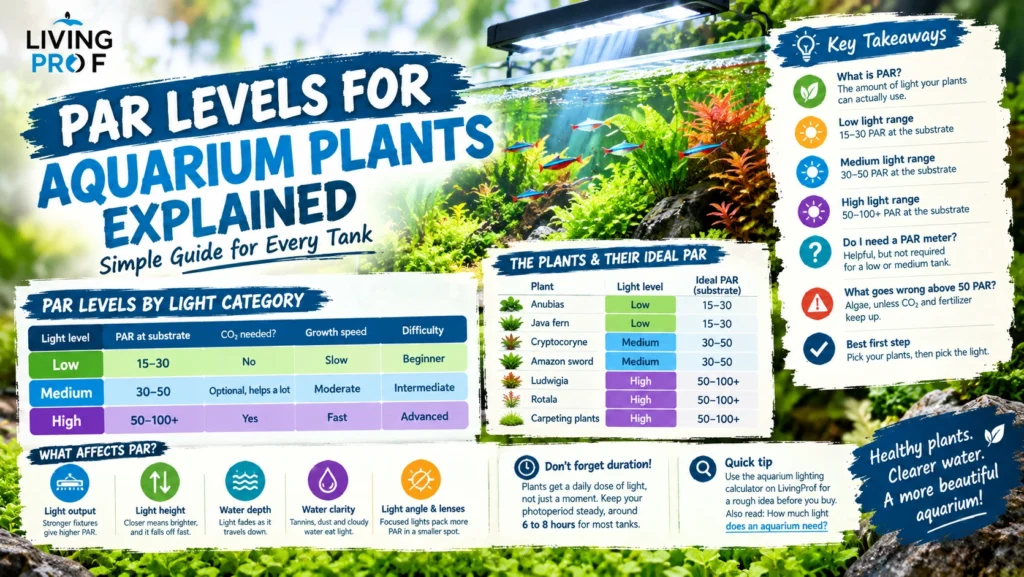
Key Takeaways
| Question | Quick answer |
|---|---|
| What is PAR? | The amount of light your plants can actually use |
| Low light range | 15–30 PAR at the substrate |
| Medium light range | 30–50 PAR at the substrate |
| High light range | 50–100+ PAR at the substrate |
| Do I need a PAR meter? | Helpful, but not required for a low or medium tank |
| What goes wrong above 50 PAR? | Algae, unless CO2 and fertilizer keep up |
| Best first step | Pick your plants, then pick the light |
Your plants don’t care about the watts on the box. They care about how much usable light reaches their leaves. That number is PAR, and once you get it, buying lights gets much easier.
I killed a lot of stem plants before I learned this. I bought a bright light because the reviews looked great, then watched green algae cover my glass in two weeks. Ever wondered why the same light works in one tank and wrecks another? Depth and plant choice explain most of it. 🙂
What PAR Actually Measures
PAR stands for Photosynthetically Active Radiation. It counts the light in the 400 to 700 nanometer range, because plants use that range to grow. Most meters show it in micromoles per square meter per second, written as µmol/m²/s.
Watts and lumens tell you much less. Watts measure the power a light pulls from the wall. Lumens measure brightness to human eyes, and our eyes love green and yellow light while plants use plenty of red and blue. Two lights with the same lumens can give very different PAR.
So PAR gives you a number you can compare. You measure it at a specific spot, usually the substrate, and that tells you what your carpet plants get. A reading near the surface looks huge, but your plants sit way down below it.
Here’s what drives PAR in your tank:
- Light output: stronger fixtures give higher PAR
- Height of the light: closer means brighter, and it falls off fast
- Water depth: light fades as it travels down
- Water clarity: tannins, dust and cloudy water eat light
- Light angle and lenses: focused lights pack more PAR in a smaller spot
PAR alone doesn’t tell the whole story. Duration matters too, since a plant gets a daily dose of light, not just a single moment. People call this the daily light integral, but you can skip that term. Just keep your photoperiod steady, around 6 to 8 hours for most planted tanks.
If you want a quick starting point, try the aquarium lighting calculator on LivingProf. It gives you a rough idea before you spend anything. For the basics on brightness and hours, read how much light does an aquarium need.
One more thing. PAR doesn’t care what your light looks like. A cheap light and an expensive one can hit the same number at the substrate. The expensive one might look nicer to your eyes, and that’s fine, but your plants can’t tell the difference.
PAR Levels by Light Category
Hobbyists split planted tanks into three groups. The exact lines move a little depending on who you ask, but these ranges work for me and for most people I know. Measure at the substrate, not the surface.
| Light level | PAR at substrate | CO2 needed? | Growth speed | Difficulty |
|---|---|---|---|---|
| Low | 15–30 | No | Slow | Beginner |
| Medium | 30–50 | Optional, helps a lot | Moderate | Intermediate |
| High | 50–100+ | Yes | Fast | Advanced |
Low light tanks
Low light tanks are the easiest to keep. You can run them without CO2, with a basic fertilizer, and still get a nice green look. Growth is slow, so trimming is rare and algae stays calm.
I started here and I still love these tanks. A betta or a group of small tetras looks great in one. If you keep a betta, the betta fish care guide covers the rest of the setup.
Medium light tanks
Medium light is the sweet spot for most people. You get more plant choices and faster growth, and you can still skip CO2 if you accept slower results. Add CO2 and the same light works even better.
High light tanks
High light gives you carpets, bright red stems and that sharp, dense look from aquascaping contests. It also punishes mistakes. Miss one fertilizer dose or let CO2 drop and algae shows up fast.
FYI, some people chase high light because it looks impressive on forums. IMO, a healthy medium light tank beats a messy high light tank every time.
A good rule: match PAR to your skill level too. Start low, move to medium once you stop killing plants, then try high when you feel steady. You will save money and stress that way.
Which Plants Fit Which PAR Level
This is where most people should start. Choose your plants first and the light second, since swapping a light costs more than swapping a plant.
| Plant | Light level | Ideal PAR (substrate) | Notes |
|---|---|---|---|
| Anubias | Low | 15–30 | Tie it to wood, don’t bury the rhizome |
| Java fern | Low | 15–30 | Very forgiving |
| Cryptocoryne | Low–Medium | 20–40 | Can melt after a move |
| Amazon sword | Medium | 30–50 | Heavy root feeder |
| Vallisneria | Medium | 30–50 | Spreads with runners |
| Ludwigia | Medium–High | 40–70 | Turns red under strong light |
| Rotala | High | 60–100 | Needs CO2 and steady feeding |
| Dwarf hairgrass | High | 50–80 | Carpets only in strong light |
| Monte Carlo | High | 60–100 | Stays flat only with plenty of light |
Notice how Anubias and java fern sit at the top of the beginner list. They grow on wood and rock, soak up nutrients from the water, and shrug off weak light. Too much light on them just grows algae on their slow leaves.
Mixing plants with different needs
You can mix light levels in one tank. Put the high-light plants in the bright zone and the low-light plants in the shade under wood or tall stems. I did this in a 40 gallon tank, with Rotala up front and Anubias tucked in the back corner. Both thrived.
Fish choice matters here too. Some fish dig up carpets, and some eat soft leaves. Corydoras root through sand and can pull small plants loose, so a coarse planting hold helps. The corydoras catfish care guide shows how to set up a tank they like. Angelfish need height and love tall plants like Vallisneria, and the angelfish habitat guide has more.
Want to browse more species before you plan the planting? The aquarium fish section lists them all in one place.
Last tip for this part. Buy plants in small groups, not one by one. A cluster of five stems grows faster and looks better than five lonely stems. Yeah it costs a bit more at the start, but you save weeks.
How Depth and Tank Size Change Your PAR
Here’s the part that surprised me most when I got my first meter. PAR drops fast as water gets deeper. A light that gives 120 PAR near the surface might give only 40 at the bottom of a deep tank.
Why does it fall so quick? Water absorbs light, and so do dissolved particles. Light also spreads out as it travels, so the spot gets bigger and dimmer. The result looks something like this:
| Tank depth | Typical PAR loss from surface to substrate |
|---|---|
| 12 inches (30 cm) | Moderate |
| 18 inches (45 cm) | Large |
| 24 inches (60 cm) | Very large |
I’m not giving exact percentages because every light and lens behaves differently. A focused LED loses less than a wide-spread tube. You need to measure your own setup, or check what the maker publishes for your tank height.
What this means for tall tanks
A tall tank often needs a stronger light than a shallow tank of the same length. A 24 inch deep aquarium can starve its carpet plants even with a light that works fine on a 12 inch tank. Plants on top of hardscape get more light than plants at the base, so you can use that trick too.
Raise the light, lower the light, and watch what changes. Lifting a fixture a few inches can drop PAR a lot, which is handy when algae starts growing. Lowering it can fix slow growth without buying anything new.
Tank size and volume
Bigger tanks need more fixtures or longer lights to cover the whole floor. Light spreads evenly in a small cube but gets patchy in a long tank. A 6 foot tank with one light in the middle leaves dim spots at both ends.
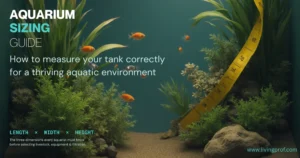
Know your actual volume before you buy gear. The tank volume calculator gives you gallons or liters in a few seconds. Then compare it with the tank capacity and equipment guide so your light, filter and heater all fit the same tank.
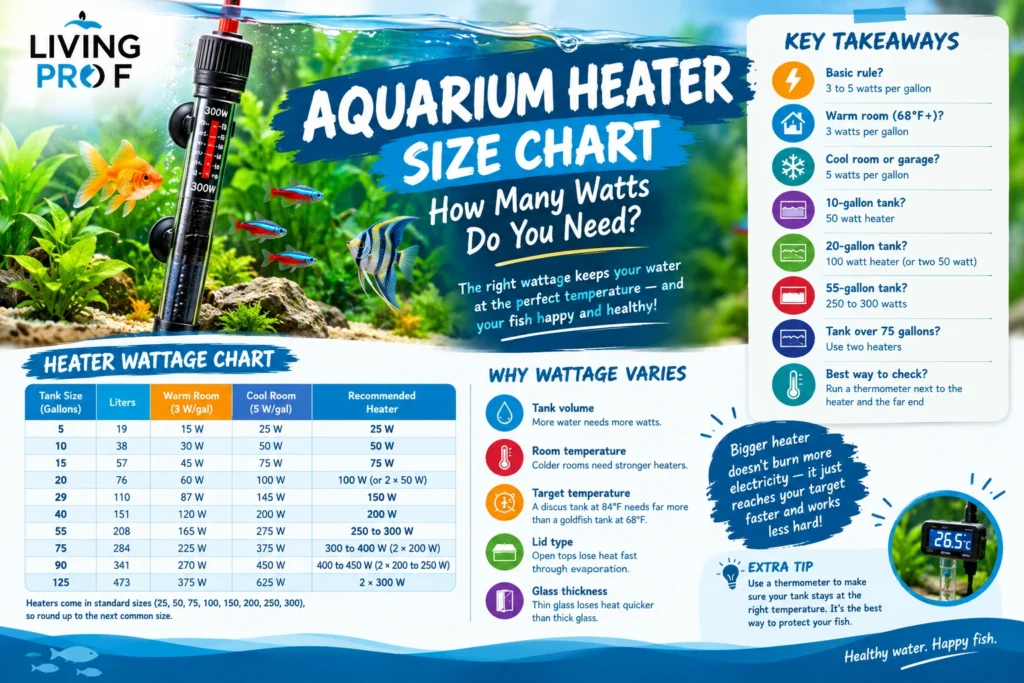
Heater size matters here too since a bigger tank needs more power, and the aquarium equipment sizing guide walks through the matching.
How to Measure PAR Without Guessing
Do you need a meter? It depends on how serious you want to get. For a low light tank with Anubias, skip it and save the money. For a high light carpet, a meter pays for itself in plants you don’t lose.
Option 1: Buy or borrow a PAR meter
A quantum PAR meter reads light right in the water, which gives the most accurate number. Good ones cost a few hundred dollars. Some local fish clubs lend them out, and a few shops will measure your tank for a small fee.
Here’s how I take a reading:
- Turn the light on and let it warm up for 10 minutes.
- Turn off the room lights so they don’t add extra light.
- Place the sensor at the substrate where your plants will sit.
- Take readings in several spots, at least the corners and the center.
- Write the numbers down and average them.
Most tanks give uneven readings. The center is often brighter than the corners, and I wasn’t surprised when mine was nearly double.
Option 2: Use the maker’s PAR charts
Many aquarium lights publish PAR charts for different tank heights. These give you a decent estimate without any gear. Treat them as a guide, since your water clarity and your light position change the real number.
Option 3: Watch your plants
No meter, no chart? Your plants tell you the answer. Slow growth, pale new leaves and long stretched stems mean too little light. Algae on leaves, melted tips and plants that hide their color under green film mean too much.
I used this method for years before I owned a meter. It works if you stay patient and change one thing at a time. If you change the light, the fertilizer and the CO2 all in one week, you won’t know which fixed the problem.
Keep a short notebook. Date, light height, hours, and what happened. It sounds boring, but it saved me many times when I forgot what I changed.
Matching Lights, CO2 and Fertilizer to Your PAR
Light is one leg of a three-leg stool. Light, CO2 and nutrients must stay in balance. Raise one and the other two must rise with it, or algae wins.
| PAR range | CO2 | Fertilizer | Typical outcome |
|---|---|---|---|
| 15–30 | Not needed | Light dosing, root tabs | Slow, steady growth |
| 30–50 | Helpful | Regular liquid + root tabs | Good growth, easy to manage |
| 50–100+ | Required | Frequent dosing, nutrient-rich soil | Fast growth, needs close attention |
Picking the right light
Once you know your target PAR, you can shop with a plan. Pick a light that hits the number at your tank depth, with a dimmer so you can fine-tune it. Dimmable lights save you, because you can start low and raise the intensity slowly over weeks.
Our best LED aquarium lights buyer’s guide compares current options and shows which ones suit planted tanks. Pair it with the aquarium lighting calculator to check coverage for your size.
Adding CO2
Past about 50 PAR, plants use light faster than the water can supply carbon. Injecting CO2 fills that gap. Without it, you get stalled plants and plenty of algae.
You have two kinds of CO2 systems, pressurized and DIY yeast. Pressurized setups give steady control, and I trust them more for anything above medium light. The best CO2 systems for planted aquariums guide covers setups at every budget.
Watch your fish when you add CO2. Too much gas makes fish gasp at the surface, and that’s an emergency. Turn the CO2 off and add an air stone if you see it. Also run your filter output so it spreads the gas evenly, which the aquarium filtration 101 guide explains.
Feeding the plants
Strong light makes plants hungry. Nitrogen, phosphorus, potassium and trace elements all run out faster at high PAR. A weekly water change plus steady dosing keeps levels from crashing.
My own routine is simple. I dose in small amounts several times a week, I change about half the water weekly, and I test now and then. Boring, yes, but it works.
Fixing Algae and Weak Growth With PAR Changes
Algae is the number one reason people quit planted tanks. Most of the time, it comes from light that outruns CO2 and nutrients. Fix the balance and the algae fades.
Signs of too much light
- Green spot algae on glass and slow leaves
- Hair algae or thread algae on stems
- Brown film on new setups
- Plants growing fast but with holes and melted tips
- Water turning green after a few days of bright light
If you spot these, cut your light time first. Drop from 8 hours to 6, or lower the intensity by 20 percent. Wait two weeks before judging, because plants and algae both react slowly.
Signs of too little light
- Tall, stretched stems reaching for the surface
- Pale or yellow new growth
- Red plants staying green
- Carpets that won’t spread
- Slow growth for months
For these, raise intensity a little or move the light closer. Make one small change at a time, then watch for two weeks.
A simple fix routine
- Check the photoperiod and cut it to 6 hours if it’s longer.
- Clean the glass and remove visible algae by hand.
- Do a large water change, around 50 percent.
- Confirm CO2 is steady and your fertilizer dosing is on schedule.
- Lower light intensity if the problem stays.
Cloudy water often shows up with light problems, but it has other causes too. Our guide on why aquarium water goes cloudy helps you sort bacterial blooms from green water. Sick fish sometimes follow poor water, so keep the common freshwater fish diseases guide handy.
Fish often help control algae, but they can’t fix a bad balance. Plenty of people buy algae eaters to solve a light problem, and that rarely works. Fix the cause, then add the cleanup crew.
PAR FAQ and Final Thoughts
What PAR level do most aquarium plants need?
Most common plants do well between 30 and 50 PAR at the substrate. Low light plants like Anubias are happy at 15 to 30, and demanding carpets want 50 to 100.
Can I grow plants with a standard hood light?
Yes, for low light plants. Anubias, java fern and some Cryptocoryne grow under basic lights. Demanding plants need a stronger fixture.
How many hours a day should my planted tank light run?
Aim for 6 to 8 hours. Start at 6, and only raise it if plants grow slowly and algae stays away.
Do I need CO2 for medium light?
You don’t need it, but it helps a lot. With CO2, medium light gives faster growth and better color. Without it, expect a slower tank that’s easier to run.
Does water depth really change PAR?
It does, and by a lot. Deeper tanks lose more light before it reaches the substrate, so a tall tank needs a stronger light than a shallow one.
Is a PAR meter worth buying?
For a high light tank, yes. For a simple low light tank, no. Many clubs and shops will measure it for you.
Why do I get algae with high PAR?
Algae thrives when light is strong and CO2 or nutrients run short. Balance all three and algae drops.
Can planted tank lighting hurt my fish?
Bright light won’t hurt most fish, but they need shade. Add floating plants, wood and tall stems so fish can hide from the glare. Timid fish like bettas and discus appreciate it.
Final Thoughts
PAR sounds technical, but the idea stays simple. Pick plants, match the light to them, and keep CO2 and fertilizer in step. Start low, measure what you can, and change one thing at a time.
I still get it wrong sometimes, and I’ve kept planted tanks for years. That’s part of the fun IMO. When you want to plan your next tank, try the free LivingProf tools, read about a peaceful community fish setup, and then go build something green. Your future self (and your fish) will say thanks.
For more guides like this, visit LivingProf.